

Introducing the Mercedes GLB EQ: Successful on the second attempt?
The GLB EQ comes quite close to the recently introduced Mercedes GLC EQ in some areas. It also costs less, without being cheap, of course.

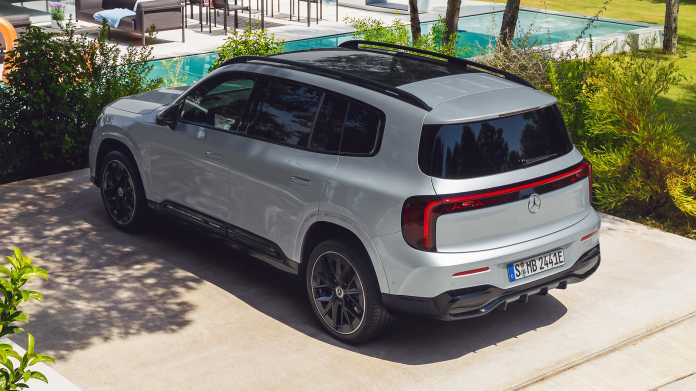
Mercedes surprises with the second GLB in two ways. Firstly, the rear side line in particular is reminiscent of the Smart #5. Secondly, the group is sticking to the concept of offering two similarly sized SUV models. Previously, there were differences with primary rear-wheel drive and a torque converter automatic on the one hand – that of the GLC – and primary front-wheel drive and a dual-clutch transmission in the EQB/GLB, which shaped the driving experience. This will be eliminated with the model change. The GLB EQ, like the GLC EQ, will have rear-wheel drive.

Grown
The new GLB will be slightly larger than its predecessor. In length, it gains 4.8 cm to 4.73 m, and in width, it is 2.7 cm wider at 1.86 m. The wheelbase grows by 6 cm to 2.89 m. The GLB is a five-seater as standard; two additional seats in the third row are available for an extra charge. However, the trunk will then be little more than a small storage space – Mercedes doesn't even state this volume. As a five-seater, this part of the luggage compartment holds 540 liters. If you have ordered the third row but are not currently using it, you can load 480 liters. The compartment under the front hood is remarkably spacious at 127 liters. The maximum towing capacity is also generously designed at two tons.
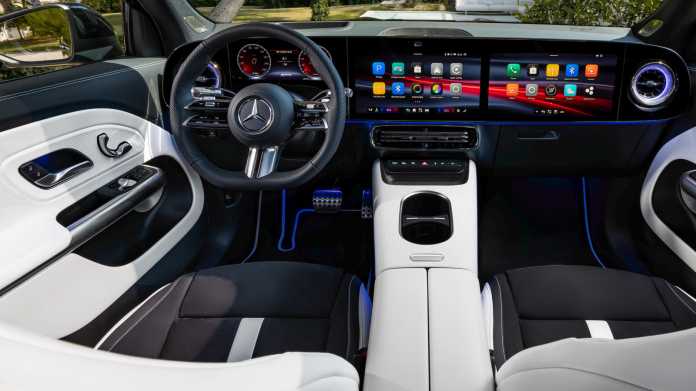
Mercedes GLB EQ innen (9 Bilder)
Mercedes-Benz
)Inside, the driver and guests can expect the design that has now become familiar from several new releases this year. There is an instrument panel dominated by screens, optionally also with a passenger display. MB.OS serves as the operating system. A first drive with the CLA EQ showed that the voice control has been further improved. It is recommended to everyone to at least give it a chance, as it significantly simplifies access. Unlike before, a large glass roof is standard, but there is no longer any possibility to open it.
Also available with combustion engine again
Originally, the combustion engine was supposed to be a thing of the past with this model change, but Mercedes changed course during development. In addition to the battery-electric drives, which the responsible parties want to focus on, three mild hybrids are planned. Mercedes has not yet revealed the performance data for the SUV; they are to be communicated next year. An offer similar to the CLA, where the hybrids are offered with 100, 120, and 140 kW, is conceivable, indeed likely. Unlike in the electric car, front-wheel drive is the primary drive here, and the rear axle is only engaged in the all-wheel-drive model when needed. An eight-speed dual-clutch transmission is standard.
The buffer battery has up to 1.3 kWh, Mercedes writes. With very low load requirements, electric driving is even possible. This is, of course, at best a supplementary feature, because the core idea is variable load point shifting: the combustion engine is intended to operate as close as possible to its best efficiency whenever possible. The intake valves close earlier than usual to enable better utilization of expansion in the so-called "Miller combustion process" and thus further increase efficiency. Mercedes has not yet provided consumption figures.
Two electric drives at the start of sales
In any case, the three mild hybrids are overshadowed by the battery-electric drives. At the start, there will be a rear-wheel-drive model (GLB 250+ EQ) with 200 kW and 335 Nm and an all-wheel-drive model that adds an electric motor with 80 kW to the front axle. The GLB 350 4Matic thus achieves a system output of 260 kW and a maximum torque of 515 Nm. Many manufacturers use an asynchronous motor for the secondary drive, which can be more energy-efficient to drag along without load but has other disadvantages. Mercedes, on the other hand, uses two synchronous motors and, incidentally, claims to have massively reduced the proportion of rare earth metals.
Slowly, very slowly, the focus of interest in electric cars is shifting from the pure "And-how-far-can-you-go debate" to a slightly broader perspective. In WLTP, Mercedes specifies a range of 542 to 631 km for the 250+ and 521 to 614 km for the 350 4Matic. In both cases, a NMC battery (Nickel-Manganese-Cobalt) with a usable capacity of 85 kWh is installed. Mercedes is taking a huge step forward in charging, which could at least somewhat alleviate some concerns. At its peak, the GLB charges at up to 320 kW. Within 10 minutes, up to 260 km of WLTP range should be replenished. The first press release is still missing a value for charging from 10 to 80 percent, but we assume that this value will be identical to that of the CLA EQ. There it is 22 minutes. This would mean an average net charging power of around 162 kW.
Videos by heise
620 km on the Autobahn
A speculative example calculation for illustration: You start with 100 percent and drive the battery down to 10 percent. On the Autobahn, assuming you don't aim for particularly high consumption, this should be at least around 350 km with some additional buffer. After charging to 80 percent, another approximately 270 km would be added. With a break of 22 minutes, around 620 km would thus be possible – as mentioned, calculated with some buffer. This won't win over those who want to travel 1000 km without a stop, but possibly some remaining interested parties.
Mercedes GLB EQ außen (4 Bilder)
Mercedes-Benz
)Limitations when charging
There are two limitations when charging: as with the CLA EQ, the GLB EQ will only be able to charge at 400-volt DC charging stations if corresponding optional equipment has been ordered. While this does not apply to all public DC chargers, it can be quite inconvenient in some cases. Hopefully, an attentive programmer has remembered to hide incompatible charging stations in the navigation system for GLB models without this extra. Potential buyers should also consider that only an 11 kW AC charger is installed as standard. Those who want to charge at 22 kW AC power must also order this ex-factory.
Less expensive than the GLC
Perhaps it will be of some consolation that the GLB EQ costs less than the GLC EQ. Of course, it's not cheap. The preliminary base model is advertised at 59,048 euros, and the 350 at 62,178 euros. This is an extremely confident statement, as the GLB entry-level price is significantly above electric cars like the Skoda Enyaq, BMW iX1 (Test), or the Smart #5. A base model for slightly less money is to follow, but even here, interested parties should not harbor exaggerated hopes: With the equipment chosen by most, no GLB EQ will cost significantly less than 60,000 Euros. Mercedes' first foray into the world of electromobility was not particularly successful. The second, however, comes with a bold pricing strategy.
(mfz)