


3D Print: Startup Creates Affordable Music Instruments with Studio Sound Quality
String instruments made with traditional woodworking are expensive. There must be a more affordable way to achieve sound quality. The solution is 3D printing.
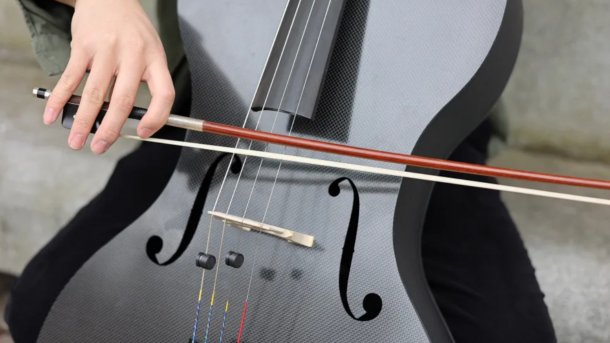
The cello from Forte3D combines carbon fiber plates with components from the 3D printer.
(Image: Yale Engineering)
The US-based start-up Forte3D has given a new direction to the construction of string instruments using 3D printing. With a combination of carbon fiber elements and 3D-printed parts, they are creating cellos and violins at lower prices than traditional wooden instruments. The sound of the 3D-printed versions can be adjusted through minor changes before printing and achieves professional quality.
String instruments made with traditional woodworking are expensive. The older they are and depending on their manufacturer, the more costly they become. For new cellos, for example, at least 5000 US dollars and more are required, explains Forte3D co-founder Elijah Lee, who is currently completing his degree in engineering at Yale University. The instruments are also less robust, which makes handling them more difficult.
String Instruments from the 3D Printer
Lee therefore sought a way to make these instruments lighter, more durable, and their production more affordable. The company combines carbon fiber and polymer materials, completely foregoing wood. For example, the cello offered by Forte3D was conceived from scratch, without replicating a wooden cello. The top and back consist of flat, concave carbon fiber plates. The ribs and neck are produced using the 3D printing process. This also applies to the sound post, the fingerboard, and the bridge.
The instrument is printed on a special 3D printer, which Lee and his co-founders built in their basement lab in such a way that the basic structure of a cello can be printed in one piece. The manufacturing process takes only a few hours, compared to months for a handmade string instrument.
The instruments created in this process are light, robust, can withstand temperature fluctuations, and are designed for daily use. The sound is said to be full and resonant, the company promises. The sound can be further improved during the manufacturing process by adjusting the CAD design of the instrument. The shape, thickness, and material can be optimized to precisely tune the sound. "Since we use our own designs, we can really fine-tune the acoustics," explains Lee, whose company also offers individual optical design options for the instruments.
Empfohlener redaktioneller Inhalt
Mit Ihrer Zustimmung wird hier ein externes YouTube-Video (Google Ireland Limited) geladen.
Ich bin damit einverstanden, dass mir externe Inhalte angezeigt werden. Damit können personenbezogene Daten an Drittplattformen (Google Ireland Limited) übermittelt werden. Mehr dazu in unserer Datenschutzerklärung.
For six years, Lee and his colleagues worked on the concept, materials, and printing process. It took hundreds of iterations until the first cello was finished and sounded as the inventors had imagined.
"It was a gradual process, but when we assembled the first fully realized cello, I thought, 'Okay, wow, we've really achieved something here.' That moment made everything worthwhile," Lee recounts.
Financing via TV Show
Financing is secured by a deal that Forte3D closed with investor Lori Steiner on the TV show "Shark Tank" (roughly the equivalent of the German "Höhle der Löwen") in November 2025. Forte3D now has 250.000 US dollars available, but the start-up had to give up 16 percent of its company shares for it.
Videos by heise
In addition to the 3D-printed cello, the company has also released a violin. The fresh capital will now be used to develop violas and double basses. With their affordable musical instruments, which cost about half as much as their wooden counterparts, the company founders hope to simplify access and democratize classical music. Everyone should be able to afford a string instrument with good sound without having to make huge investments, that's the goal. "Music shouldn't be limited by price or delicate wood," says Lee.



(olb)

