


Four 4K displays, 220-degree field of view: Hypervision's VR prototype
Hypervision develops VR lens systems that combine a wide field of view with a compact design, showing where the VR journey is heading in the long term.
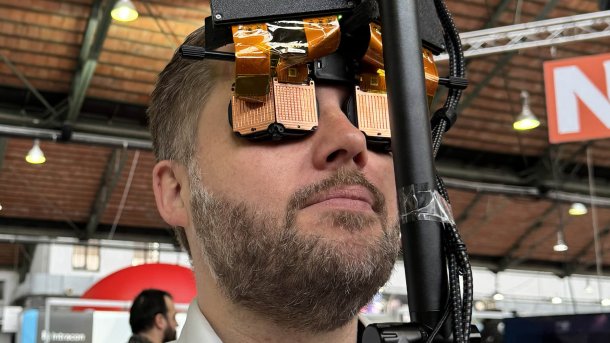
The research prototype "Hypervision Ultraslim 220".
(Image: Christian Steiner)
The development of VR glasses is contradictory: while the resolution of the displays has significantly increased in the past ten years, the field of view has largely stagnated. Most devices still offer around 100 degrees horizontally and vertically. Systems with a significantly larger field of view, on the other hand, are often larger, heavier, and less suitable for everyday use.
Meta demonstrated this summer with new research prototypes that combine a wide field of view with a surprisingly compact design, proving that it can be done differently. The start-up Hypervision, which has been working on commercial lens systems for VR headset manufacturers since 2020, is operating precisely at this intersection. At the UnitedXR Europe trade fair, the company presented two reference designs, including one that could soon be incorporated into commercial VR headsets.

Ultraslim 220: High-resolution, wide-angle, and exorbitantly expensive
The first and technically more demanding reference design is called "Ultraslim 220". The name says it all: the research prototype offers a distortion-free field of view of 220 degrees horizontally and 94 degrees vertically with a surprisingly space-saving design.
To achieve this wide field of view, the reference design combines two 4K OLED microdisplays and two pancake lenses per eye: one pair for the central and one pair for the peripheral field of view. The lenses are bonded together in the front area and have a seam that almost disappears when looking through, as VR veteran Christian Steiner was able to see for himself on site.

(Image: Christian Steiner)
According to Steiner, the seam is still slightly visible when moving the head because there is a narrow blur area at this point. However, he assumes that this can be resolved through improvements to the prototype. The sharpness of the image is also impressive: thanks to the two 4K displays per eye, the prototype achieves a pixel density of 48 pixels per degree, an exceptionally high value given the wide field of view.
Empfohlener redaktioneller Inhalt
Mit Ihrer Zustimmung wird hier ein externes Video (TargetVideo GmbH) geladen.
Ich bin damit einverstanden, dass mir externe Inhalte angezeigt werden. Damit können personenbezogene Daten an Drittplattformen (TargetVideo GmbH) übermittelt werden. Mehr dazu in unserer Datenschutzerklärung.
Hypervision already presented the same architecture three years ago. What's new about the Ultraslim 220 is the use of OLED microdisplays instead of LCDs for the first time. This presented a challenge for the start-up, as OLED microdisplays are significantly smaller and therefore require stronger optical magnification. However, the small size also brings advantages: it allows for a more compact headset housing, even if this can only be guessed at from the raw experimental setup of the Ultraslim 220.

(Image: Hypervision)
Christian Steiner finds it unusual how close the lenses are to the eyes, so close that they touch the eyelashes and make corrective lenses indispensable for eyeglass wearers. The design reminded him once again how wide the human field of view actually is and that even 220 degrees are not enough to cover it completely. Even if the peripheral area only serves to convey the feeling of presence in VR, this significantly increases immersion.
Videos by heise
This lens system will not appear in commercially available devices anytime soon. With manufacturing costs of around 10,000 US dollars, the reference design is primarily intended for industrial and military applications.
PanoVR1: A solution for the mass market
The second reference design presented at the trade fair, "PanoVR1", is significantly more affordable thanks to its simpler architecture and offers technical features more tailored to the needs of the consumer market. Pancake lenses are also used here.
While the horizontal field of view is only 160 degrees in comparison, the vertical field of view, which is so important for immersion, has been extended to 120 degrees. Hypervision also presented this reference design earlier. What's new are the 2.7K LCD panels from TCL, which enable a higher pixel density of 28 PPD and offer better black levels thanks to local dimming.

(Image: Christian Steiner)
A VR headset with this lens system would outperform the Meta Quest 3 in three important aspects: field of view, resolution, and contrast, which approaches OLED levels thanks to local dimming. Since PanoVR1 uses LCDs instead of OLED microdisplays, the construction is not quite as compact as with the Ultraslim 220.
To offer PanoVR1 at a marketable price, Hypervision is currently working with several partners to lay the groundwork for mass production. These preparations are expected to be completed next year. Marketing of the lens system therefore seems not too far off.
A VR headset with Hypervision technology is already in the starting blocks: the French start-up Lynx will present the successor to its mixed reality headset Lynx R-1 in January and has announced that it will have the widest field of view of any standalone VR headset to date. According to Hypervision's CTO Arthur Rabner, it is a different lens system than PanoVR1, which does not offer quite as wide a field of view. However, this is not necessary, as the new Lynx device relies on mixed reality with an open periphery.
A wide field of view presents standalone VR headsets with significantly greater challenges than PC VR devices. Due to the larger image area, considerably more pixels and objects need to be rendered. This quickly pushes mobile chips to their limits and increases heat generation: both factors that limit standalone devices and deter manufacturers like Meta from aiming for a wider field of view than before.
The required computing power is demonstrated by Meta's research prototype „Boba 3“ with a field of view of 180 degrees horizontally and 120 degrees vertically, which was demonstrated at SIGGRAPH this year: it was powered by an RTX 5090. A particularly wide field of view is therefore likely to remain the domain of PC VR headsets for a long time to come.


(dmk)

