


Panther Lake: Intel introduces 14 Core Ultra 300
Intel is revealing concrete specifications for the Panther Lake processors. However, power consumption is increasing in some areas.
(Image: Intel)
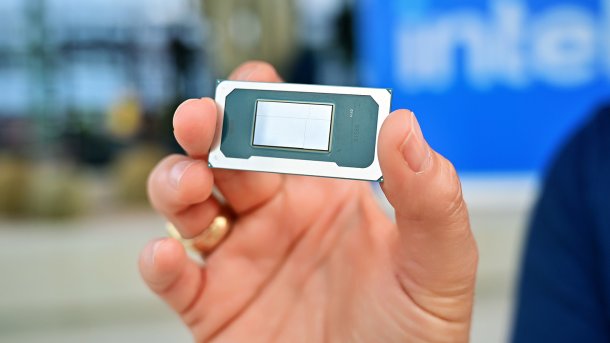
Intel is introducing 14 notebook processors from the Panther Lake family, also known as the Core Ultra 300. The manufacturer is revealing a key metric for the first time: electrical power consumption. There are advancements and setbacks in this regard.
Base power consumption increases
Bad news for particularly compact and quiet notebooks: there are no more 15-watt models. Instead, Intel is raising the minimum electrical power consumption (Processor Base Power, PBP) to a consistent 25 watts. This potentially complicates cooling.
In return, the maximum electrical power consumption (Maximum Turbo Power, MTP) is decreasing from 115 watts in the Core Ultra 200H (Arrow Lake-H) to a standard 65 watts. The smaller processors with a maximum of eight CPU cores will suffice with 55 watts.
Panther Lake is intended to operate very efficiently, especially at low loads: according to Intel, a Lenovo IdeaPad with the new top model Core Ultra X9 388H should last 27 hours while streaming Netflix.

(Image: Intel)
The classic division into Watt classes U and H is being dropped. As with desktop processors, there are models without any suffix and additionally H-types with a new meaning: they use the larger CPU chiplet with 12 to 16 cores and optionally support an increased base power of 45 watts as well as a turbo up to 80 watts.
Intel already introduced the technology of Panther Lake last October. This includes new CPU cores in the form of Cougar Cove (performance cores) and Darkmont (efficiency and low-power efficiency cores). Intel is upgrading the graphics architecture to Xe 3, also known as Celestial. All types also integrate a quite powerful AI unit that can achieve at least 46 trillion operations per second (TOPS).
Core Ultra X9 enters the stage
The X in the top model, Core Ultra X9 388H, among others, stands for the full GPU configuration with twelve Xe cores. On the CPU side, there are four performance, eight efficiency, and four low-power efficiency cores. Intel specifies the maximum clock frequency at 5.1 GHz.
The Core Ultra 9 386H is almost identical, apart from the weaker “Intel Graphics.” Only the CPU clock frequency is slightly lower at a maximum of 4.9 GHz.
The fastest model limited to 55 watts is the Core Ultra 7 365. With four performance and four low-power efficiency cores each, it is most similar to Lunar Lake.
The two chiplet variants with the CPU cores are manufactured for the first time by Intel using its own new 18A technology. The smaller GPU variant with four Xe cores is produced using the Intel 3 manufacturing process. The large GPU with twelve Xe cores, however, is produced by the chip contract manufacturer TSMC using the N3P process.

(Image: Intel)
No CPU benchmarks yet
At the CES 2026 tech show, Intel is focusing primarily on the powerful GPU for its introduction. It is expected to increase by up to 77 percent compared to Lunar Lake (Core Ultra 200V). However, for evaluating the 18A process, CPU performance is most interesting, for which Intel has only made rough relative statements so far.
For example, the single-threaded performance of a single-performance core is expected to increase by ten percent compared to Lunar Lake at the same electrical power consumption. Multi-threaded performance is expected to increase by at least 50 percent thanks to the doubled core count at the same power consumption.
The Core Ultra X9 388H is said to be “up to 60 percent faster in multi-threading tests of the Cinebench 2024 benchmark at similar electrical power consumption.” The manufacturer does not provide specific scores.

(Image: Florian Müssig / heise medien)
Available from the end of January
Notebooks with Panther Lake are expected to be available from January 27, 2026. Pre-orders will start on January 6th. Intel promises further device introductions in the coming months. Gaming handhelds with these processors are also expected to be released later in the year.
heise medien is an official media partner of CES 2026.

(Image: Florian Müssig / heise medien)


(mma)


