


Newly discovered asteroid rotates at record speed
The Vera C. Rubin Observatory has already delivered spectacular images. On them, researchers have found an asteroid that rotates at a dizzying speed.
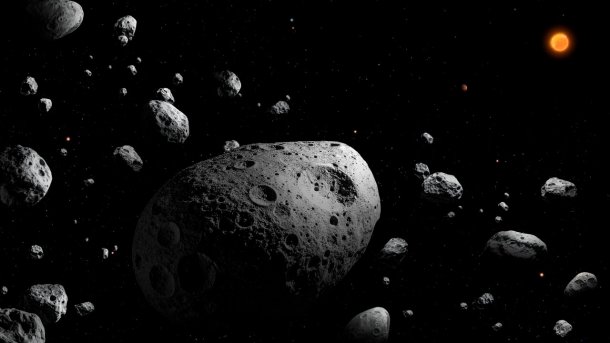
Artistic depiction of asteroid 2025 MN45
(Image: NSF–DOE Vera C. Rubin Observatory/NOIRLab/SLAC/AURA/P. Marenfeld)
The Vera C. Rubin Observatory was commissioned just over half a year ago. In its very first images, astronomers have already discovered a celestial body of record-breaking proportions: a very rapidly rotating asteroid.
The asteroid, designated 2025 MN45, is approximately 710 meters in size. It rotates in 113 seconds, less than two minutes, to complete a full turn – for comparison: Earth takes 24 hours. This makes 2025 MN45 the fastest-rotating asteroid in the class of asteroids larger than half a kilometer, as the discovery team led by Sarah Greenstreet from the National Optical-Infrared Astronomy Research Laboratory (Noirlab) writes in the journal The Astrophysical Journal Letters.
Asteroids rotate at different speeds. Their respective rotation speeds provide clues about their origin and history. A high rotation speed could be the result of a collision with another asteroid. This means the asteroid could be a fragment of an originally larger object.
The faster, the more stable
Furthermore, the rotation speed can indicate the composition: a rapidly rotating asteroid must possess a certain internal strength, otherwise it would disintegrate. The faster an asteroid spins and the larger it is, the more stable it must be – like 2025 MN45.

"This asteroid clearly must be made of a material with very high strength to remain in one piece at its very rapid rotation," said Greenstreet. "We calculated that it needs a cohesive strength similar to that of solid rock."
Most asteroids in the asteroid belt between Mars and Jupiter are rubble-pile asteroids, meaning they are agglomerations of many smaller rocks held together by gravity, explains the researcher. These tend to rotate slowly: the limit is 2.2 hours, beyond which disintegration is threatened.
19 fast and ultra-fast rotating asteroids
In addition to 2025 MN45, Greenstreet's team has identified over 70 other asteroids and determined their rotation periods. Among them are 16 with very short rotation periods, between 13 minutes and 2.2 hours, as well as three ultra-fast ones that complete a full revolution in less than five minutes. All 19 are larger than 90 meters.
The Vera C. Rubin Observatory is located in Chile, on Cerro Pachón mountain at an altitude of 2647 meters. It features an 8.4-meter primary mirror and the world's largest digital camera: it is the size of a small car, weighs 2.8 tons, and has a resolution of 3200 megapixels. The telescope can survey large areas of the night sky at high speed with unprecedented resolution, making temporal changes visible. This is intended to enable the observation of short-lived phenomena such as stellar explosions. In addition, it is designed to search for asteroids and provide insights into dark matter and dark energy.
Videos by heise
The first images released in June, taken during the first week of operation, already showed nearly 2000 new asteroids and numerous celestial bodies changing their brightness, according to researchers. Among other things, the images show the Trifid Nebula and the Lagoon Nebula in the Milky Way, and a gigantic shot with around 10 million individual galaxies.


(wpl)

