


Astronomy: Supermassive black hole slowly "starves" galaxy
The James Webb Space Telescope is finding unexpectedly many "dead" galaxies in the early universe where no stars are forming. A culprit has now been found.
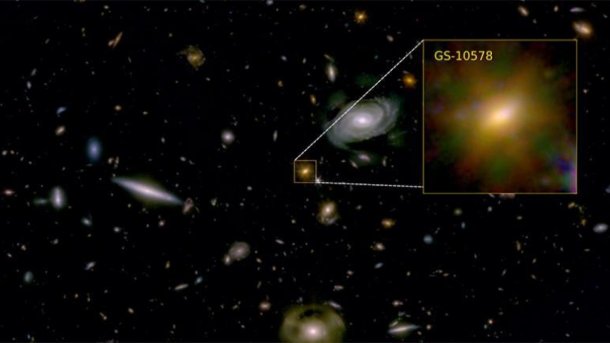
Pablo's Galaxy
(Image: JADES Collaboration)
An international research team has found a dead galaxy from the early universe whose supermassive black hole apparently prevents new stars from forming. This could answer one of the big questions raised by the James Webb Space Telescope since its commissioning, writes the University of Cambridge, where the research was led. Because with the instrument, seemingly far too many massive galaxies are being discovered that appear far too old because star formation in them ended far too early. Possibly, they are being slowly “starved” by supermassive black holes at their centers, the research group now believes.
Relatively short activity before slow death
The analyzed galaxy is designated GS-10578 and is unofficially called “Pablo's Galaxy” after its discoverer. It has about 200 billion solar masses, but most of its stars are at least 11.5 billion years old. We therefore see it 400 million years later, and at that time it was already “dead,” meaning new stars were no longer forming. However, this is not caused by a catastrophic event but by a supermassive black hole that continuously heats the raw material and pushes it out of the galaxy. The galaxy loses 60 solar masses of interstellar gas per year, meaning all the raw material for new stars would have been expelled in 16 to 220 million million years.
Videos by heise
At the same time, the research team has determined that no new gas is being added to the galaxy. Therefore, they believe it is literally being starved. For their work, the team used the James Webb Space Telescope and the ALMA (Atacama Large Millimeter Array) radio telescope network. With further measurements, the research group intends to investigate the underlying mechanism in more detail and explore whether we are indeed observing a behavior that also causes other galaxies to die slowly. The finding shows that it does not take a major catastrophe to stifle star formation in a galaxy. Their work is presented in an article in the scientific journal Nature Astronomy.



(mho)

