


Federal Gigabit Funding: 1.8 Billion for 536 Projects
Digital Minister Wildberger wants to achieve faster implementation of the Gigabit funding. Now 1.8 billion euros have been pledged for 536 projects.
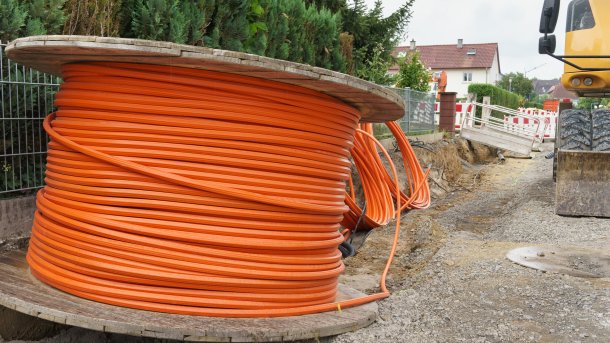
(Image: ThomBal / Shutterstock.com)
It has become comparatively quiet around the state funding for the expansion of particularly fast internet lines. This is partly due to the progress of the expansion, but also because many market participants are no longer relying so heavily on funding. Too complicated, too time-consuming, too much government, is the word from the industry. In 2024, 3 billion euros were still available. Now the funding decisions for the 2025 funding round have been approved – with 1.8 billion euros pledged.
"Fast internet is as important today as roads and railways," said Federal Digital Minister Karsten Wildberger (CDU) on the announcement of the new funding. The goal is not only for large cities to be connected, for which the state and economy would work closely together. At a festive event in Berlin, the funding decisions were handed over by Wildberger to the applicants, representing 536 successful applicants.
10 years after the handover of the first funding decisions for broadband expansion by then-Minister of Transport Alexander Dobrindt (CSU), the available speed for most customers has multiplied – but the bandwidth demand has also grown. DSL connections have not been funded for some time. Under Wildberger's predecessor, Volker Wissing, the criteria for funding were significantly changed. Wissing wanted to make funding dependent primarily on the priority needs of municipalities, after the funding pot was exhausted prematurely in 2022 on a first-come, first-served basis.
Videos by heise
Funding is not yet a connection
The funds from the federal broadband funding are actually disbursed at the earliest years later: The federal government's commitments for funding are always subject to implementation by the applicants. Over the years, a backlog of several billion euros had built up: pledged funds that the federal government must consider in its budget, but which were not billed and drawn down by the recipients. In some cases, the funding decisions were returned years later, for example, because the originally applied-for funding no longer made sense and could not have taken place at all. For Digital Minister Wildberger, who is also Minister of State Modernization, the goal is to prevent this from happening again: The key now is "professional, swift and high-quality implementation," he says. "With clear responsibilities, realistic time management, and close cooperation between the federal government, states, municipalities, and the telecommunications industry."
To what extent state-funded expansion is still necessary and effective has repeatedly been a subject of discussion recently, especially against the backdrop of slow procedures – and even more so in times of tight budgets. However, the funds for the expansion funding have not come from the normal federal budget, but from the proceeds of mobile frequency auctions. Wildberger's ministry has been consulting the industry for several months on how faster and more reliable expansion, especially for fiber optic networks, can be achieved.


(wpl)


