253 Meters Without Oxygen: Luc Besson's 'The Big Blue' in 4K Home Cinema Test
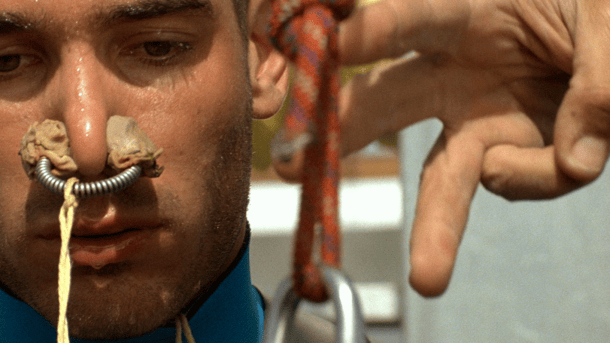
Can you hold your breath for half an hour? In 1988, Jean Reno and Jean-Marc Barr were crazy enough to make this poetic drama about apnea divers.
(Image: Gaumont)
- Timo Wolters
There is probably no extreme sport like apnea diving: Herbert Nitsch dived 253 meters deep in the ocean in 2012, and Vitomir Maričić stayed underwater for 29:03 minutes last year – both without oxygen tanks. In 1988, the French director Luc Besson – himself a sports diver – plumbed the depths of this philosophy with his film "The Big Blue." The records were still a good distance from today's figures back then, but they were fascinating nonetheless.
However, home cinema enthusiasts had to wait a long time for a technically adequate tribute to this visual masterpiece. Since mid-December, Studiocanal has been offering the film in a set with two Blu-ray discs and two Ultra HD Blu-ray discs (UHD) for just under 50 euros. It includes both the 168-minute Director's Cut and the 137-minute French theatrical version.
We are testing whether the expensive set is worth it and if it surpasses the image quality of the old Blu-ray version. We also take a look at the cheaper streaming version to see if film fans can save a few euros here. But before we dissect the technology of the spectacular underwater shots and the new restoration of the film on the following pages, let's first look at the making of this unique shoot in film history. But please don't hold your breath until the end of the article – danger to life!

(Image: Gaumont)
Taking a Deep Breath
Before Luc Besson became the epitome of hyperactive action cinema, delivering fast-paced blockbusters like "The Fifth Element" or "Lucy," he was primarily a child of the sea. To fully grasp his 1988 masterpiece "The Big Blue" ("Le Grand Bleu") in its full complexity, one must know this deeply personal background. It is by no means a mere sports documentary about apnea diving, but rather the painful cinematic processing of a tragically shattered life dream.
Besson, who practically grew up in the water as the son of Club Med dive instructors, originally wanted to become a marine biologist and spent his childhood on the coasts of Greece and Yugoslavia. However, a serious diving accident at the age of 17 abruptly ended these ambitions before they could even professionally begin.

(Image: Gaumont)
Yet, the water never let him go. He carried the initial idea for this script around with him as a teenager and worked on it for over ten years. Only after his early successes within the Cinéma du look, a French film movement of the 80s, did he manage to win over the renowned Studio Gaumont for the risky financing. "The Big Blue" became the link in his career and stands today as a melancholic monolith in his work, as Besson was never again so calm, so poetic, and so far removed from explosions or car chases.