


FireDrone: Aerogel makes fire reconnaissance drone heat-resistant up to 200 °C
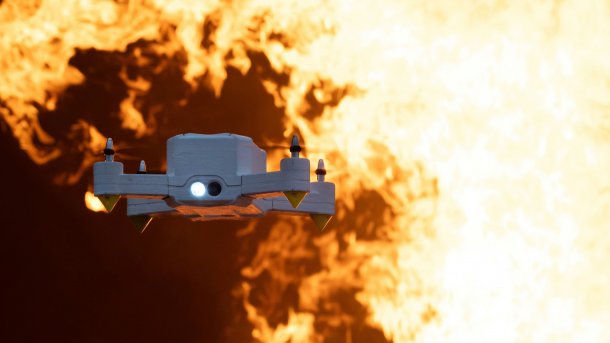
The fire reconnaissance drone FireDrone has a structure made of polyimide aerogel. The plastic allows the drone to withstand high temperatures.
(Image: Empa)
The FireDrone, further developed by the spin-off of the same name from the Swiss Federal Laboratories for Materials Science and Technology (Empa) and the École Polytechnique Fédérale de Lausanne (EPFL), has been improved in terms of its heat resistance. The drone, designed for reconnaissance flights by the fire department, for example in burning buildings, can withstand temperatures of up to 200 °C without the drone's shell or electronics being damaged. This is made possible by a high-temperature-resistant polyimide aerogel from which the drone's shell is manufactured in one piece.
During fire operations, the FireDrone, designed as a quadcopter, can be flown remotely into burning buildings to assess the situation and, if necessary, find trapped people without endangering firefighters. For this purpose, the drone is equipped with high-resolution cameras and a thermal imaging camera. The camera images are transmitted in real-time to the rescue teams' screens. The drone also has various sensors on board to determine, for example, the temperature and detect gases produced by the fire. Localization indoors is done without GPS using a specially developed pilot assistance and localization system.
Empfohlener redaktioneller Inhalt
Mit Ihrer Zustimmung wird hier ein externes YouTube-Video (Google Ireland Limited) geladen.
Ich bin damit einverstanden, dass mir externe Inhalte angezeigt werden. Damit können personenbezogene Daten an Drittplattformen (Google Ireland Limited) übermittelt werden. Mehr dazu in unserer Datenschutzerklärung.
Commercially available drones rarely withstand temperatures above 40 °C. Before the structure is damaged by heat, the electronics often start to fail first. Accordingly, the outer shell of the drone and the protection of the electronics must be heat-resistant. In a first version of the FireDrone, the developers used a glass fiber-reinforced composite structure made of polyimide and silicon dioxide. However, the various components had to be manufactured individually using a complex process.
Heat-resistant structure made of polyimide aerogel
Now, scientists at Empa have developed a high-temperature-resistant polyimide aerogel and improved it so that the material meets the required mechanical strength and flexibility in addition to heat resistance. This was preceded by extensive research work on the chemical composition, the selection of raw materials, polymerization, and solvent processes. The aerogel, which mainly consists of air-filled pores enclosed by a heat-resistant plastic, can now be cast in a single mold. It completely encases the sensitive electronic components, protecting them from heat up to 200 °C. Furthermore, a thermal management system is integrated into the FireDrone, which monitors the temperature of the components and cools them down additionally.
Videos by heise
The company is currently testing the FireDrone at the Swiss training ground of the Andelfingen training center and at the Holcim cement plant in Siggenthal. Higher temperatures are generated in the cement plant, allowing the drone to be tested under real conditions. FireDrone intends to use the drone not only for fire operations but also for inspection work wherever high temperatures occur due to chemical processes and long cooling phases prevent rapid inspections. These normally lead to long downtimes, energy losses, and high costs. Examples of such plants include cement works, steel mills, and waste incineration plants.
FireDrone is currently developing a heat-resistant, mobile docking, charging, and maintenance station: FireDrone Nest. After a mission, the FireDrone is intended to land autonomously there, dock, and be prepared for the next flight.
The tests of the drone are intended to mark the transition from a research project to a practically applicable product.



(olb)

