


Ikea USB fast charger up to 20 watts for 4 euros – bargain or junk?
Ikea is selling the 20-watt USB-C charger "Sjöss" for just 4 euros. We put the supposed bargain to the test.
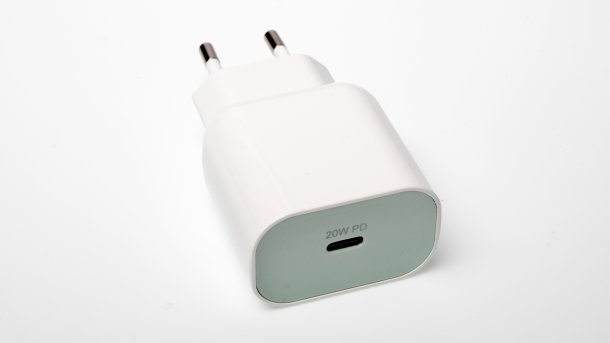
Ikea has been offering a small selection of USB chargers for smartphones for some time now. The Swedish furniture giant has now expanded its portfolio with two “Sjöss” chargers with 20 and 65 watts. Both have only one output, each in the form of a USB-C socket. The 65-watt Sjöss is said to be able to charge notebooks with the Power Delivery (PD) fast charging standard at up to 20 volts and is already very inexpensive at around 13 euros. However, we found the 20-watt model for a fantastically cheap 4 euros even more interesting. Is the USB charger even worth it for this price, or is it even dangerously flammable?
For four euros, you can hardly find anything comparably cheap, even in Amazon's virtual grab bag. And a look at the often nonsensical technical data usually leads to the conclusion that it's better not to operate such devices on the power grid. With Ikea's 20-watt Sjöss, it's different: the small power supply unit only comes with a multilingual booklet – a USB cable must be purchased separately – but it correctly informs about the capabilities of the cheap charger.
We checked the specifications and overloaded the Sjöss beyond its 20-watt limit: the USB power supply charges smartphones quickly via PD and delivers up to 15 volts depending on the requirements of the device being charged, then at a maximum current of 1.3 to 1.4 amperes. If the current exceeds the Sjöss's power limit, the voltage drops or the charger switches off – as it should. For older smartphones that don't support PD fast charging, it charges with Quickcharge or other proprietary charging methods from Samsung (AFC up to 12 volts) and Huawei (FCP up to 12 volts, SCP). Interestingly, the Ikea charger even delivers 20 volts at the USB port, but not with PD but with Quickcharge 3. Nevertheless, at 20 watts, it is not suitable for charging typical notebooks that require 20 volts, as they expect PD and, in rare cases, use Quickcharge 2 or 3.
The 20-watt charger Sjöss withstood the burst surge test at 1000 volts without any problems (a prerequisite for the CE mark required in the EU) and only reacted with a brief shutdown during the 2-kilovolt test, which is actually only necessary for industrial hardware. Unloaded, it consumed far less than 0.1 watts at the socket and was below the measurement limit of our precision power meter.


Cable missing
If you want to charge your smartphone with the 4-euro charger, you need a USB-C charging cable. You can either use the one that comes with the mobile device or add the 1-meter “Sittbrunn” cable for 2.50 euros to your Ikea shopping basket. The cable makes a mechanically robust impression – Ikea has forgone PVC and uses TPE plastic (thermoplastic elastomer) instead. Ikea doesn't specify which type exactly.
However, the Sittbrunn cable, as is typical for charging cables, does not contain lines for fast USB 3 data transfer; more than 480 Mbit/s (USB 2.0 Hi-Speed) is not possible. The simple charging cable is suitable for maximum currents up to 3 amperes, which is perfectly adequate for smartphones and tablets. If you also want to charge notebooks with 65- or 100-watt power supplies, you should opt for the 1.5-meter “Rundhult” for 10 euros. This is designed for 100 watts and can identify itself to the charger via an E-marker chip. Only then will it switch up to 5 amperes on the line if necessary. However, the Rundhult is also not suitable for fast data transfer.
In summary, we can confirm the bargain status of the 20-watt charger Sjöss for 4 euros: you can buy it with peace of mind. (rop)


