


“Fallout Season 2”: Punchlines until your head explodes
There's still something to laugh about behind the end. "Fallout" is at its best in Season 2 when it tells mean jokes.
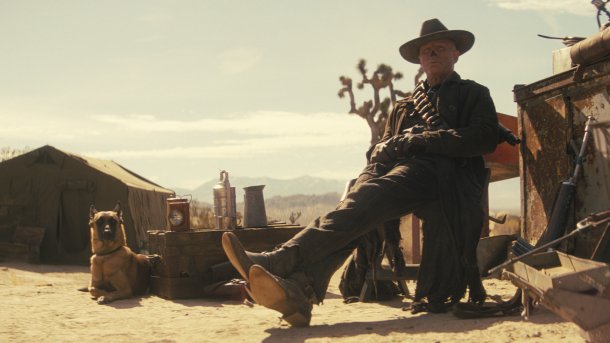
(Image: Amazon)
Why are the children in the post-apocalyptic bottle cap factory in such exceptionally good spirits? Well, because most of them would have been dead long ago at their age! A moral that is so mean and blunt that it would no longer be funny as a conventional punchline. And yet it works because it meets a particularly ignorant world: That's "Fallout". Across several computer role-playing games, the series has thrown deadly serious themes, B-movie elements, and sledgehammer satire into one pot. The unlikely mix of 1950s aesthetics, science fiction, post-apocalypse, and the Wild West has proven surprisingly robust in very different games.
Capturing the tone similarly in a TV series is a special achievement. Even after two seasons, this breathless succession of disasters and affronts is a stroke of luck.
Irradiated People
On television, the "Fallout" punchlines work similarly to the games. The fact that they often seem harsher and darker than the interactive source material is largely due to the main characters: Cooper, Lucy, and Maximus are human protagonists in a world of caricatures. They react as one might react in this hair-raising mix of "The Day After" and "Idiocracy." This makes the horror occasionally feel more real than in the games.

Perhaps there is no other way. Those who don't want to dive headfirst into "Fallout's" Monty Python references have to try to build a bridge to the viewer. What must it feel like to survive as a ghoul in the wasteland 200 years after the atomic war? How do you maintain your own code of values after growing up in a bunker of euphemisms? Despite all the satire, the series also tries to find answers to such questions in Season 2.
Watching can cause a certain whiplash due to the wild tonal shifts. The tone constantly shifts to pure satire, to the gleeful staging of unbearable stupidity. On the other hand, the story is also meant to mean something to us. How well that works despite all the weaknesses is impressive in Season 2 as well. The staging is reminiscent of a high-wire act. And if one of the artists stumbles, it's cut away.
Videos by heise
Just a Flesh Wound
"Fallout" ventures closest to reality in the pre-war scenes. The fact that the USA stumbles into a deceitful, authoritarian fascism should still be comprehensible to the audience. However, the pseudo-future in the Fifties style works more as a gag than as a setting, even in the games. Tube televisions, landline telephones, and Pip-Boys are fan service in the TV series – it really looks like "Fallout" here!
But at the latest when the digitally de-aged Kyle MacLachlan walks through sets like from "Mad Men" as Hank and looks like his face is about to fall off, you look forward to the end of the world while watching. You can't seriously imagine this pre-apocalypse. Here too, however, the acting performances are not the problem. Frances Turner as Barb and Walton Goggins as the unradiated Cooper embody a noticeably growing despair. But all the mumbling and the glassy-eyed look seem rather tiring. The world may be ending, but it's too unreal to be recognizable.
Rezension: Die zweite Staffel von „Fallout“ (7 Bilder)

Amazon
)It's rather difficult to get invested when two things always remain clear: First, everything will get worse, and second, nothing really ends. Every precarious situation, even after the apocalypse, ends with either a surprising twist or a gag.
Meanwhile Elsewhere
There are many "Fallout" games. It's remarkable how much the series works to constantly bring new factions and locations from them to the screen. On the one hand, the stories are well-told in themselves. On the other hand, "Fallout" in Season 2 often feels more like an anthology. Three protagonists move along different paths that only occasionally intersect. In addition, supporting characters get longer vignettes. What is Norm up to? What does Steph have planned? Who is this strange ghoul with a nose? Somewhere between the Snack Club war and Macaulay Culkin's appearance as a legionary, it can become a bit much. Even when binge-watching the series, the summaries at the beginning of each episode seem bitterly necessary.
The wild jumping back and forth in the story conference remains problematic until the end. This doesn't really develop any suspense. You could switch anywhere at any time.
However, the story is still entertaining, funny, and strangely touching. Of course, no one finds a happy ending here, of course, every hope for salvation must quickly lead to a nasty punchline. But that's the right way to do it. To cast a moralizing, rather pessimistic glance at humanity and then laugh about it – that's what the series does, and what the games do again and again.
Conclusion: Apt Punchlines Thanks to Heavy Artillery
How well "Fallout" has become as a television series is more noticeable when you watch others. The end-of-the-world sets, the barrage of effects, the excesses of violence look better here, are more pointed and believable than elsewhere. When watching, it makes sense that an entertaining, successful TV series can emerge from a game series with breaks, style and studio changes.
But it's not a given. It could have gone very wrong. The fact that not only the right people, but also a good script, strong actors, and a generous budget came together here is a stroke of luck. We can look forward to the third season.


(afl)

