


Chip carrier shortage: Shortage of processors and graphics cards looms
Chip manufacturers are heavily dependent on two suppliers. Their production is apparently not keeping up with current demand.
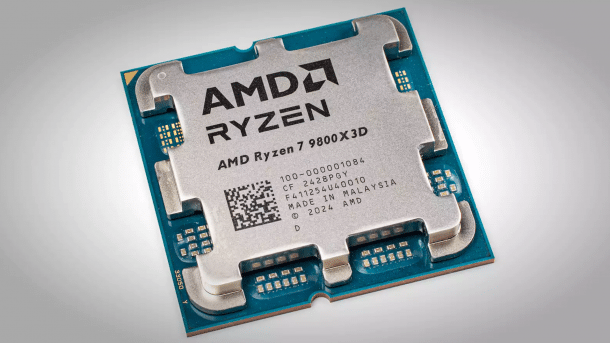
Anyone who has ever built a PC themselves has held a processor with an iconic green carrier in their hand.
(Image: heise medien)
Materials for chip carriers, also known as packages, could become scarce in 2026. Current reports focus on the Japanese supplier Nitto Boseki, also known as Nittobo, which produces so-called T-glass: glass fabric so thin that it can be rolled up like a film. But the organic material from Ajinomoto also represents a potential bottleneck.
Analysts confirm, according to the Wall Street Journal, the obvious: PC hardware is at the bottom of the food chain and thus most likely to be affected by shortages. Industry giants like Nvidia have the most money to buy up available carriers. Their focus is on high-margin AI accelerators. Server processors also require increasingly larger carriers.
The general availability would potentially be a bigger problem than any price increases. While increases of 25 percent are being discussed, this would only amount to cents or a few euros.
Glass and organic material essential
Chip manufacturers and processors use Nittobo's so-called T-glass to stabilize the carrier. It has a low coefficient of thermal expansion, thus preventing the carriers from bending or cracking under the chips. The requirements are high, as a GPU, for example, can heat up from room temperature to 100 °C in a short time.

(Image: Nittobo)
The second major supplier is the also Japanese company Ajinomoto. It is actually a food company, but as a byproduct of its seasoning sauces, it produces the so-called Ajinomoto Build-up Film (ABF). Carrier manufacturers laminate the ABF and often T-glass onto it to create stable plates with integrated copper traces. Modern desktop processors have up to 2000 traces running through a carrier; server chips have many times more.
All processors, graphics chips, programmable logic chips (FPGAs), and custom circuits (ASICs) require a carrier as a bridge between the semiconductor chip and the circuit board. This also includes all AI accelerators.

(Image: heise medien)
Near-monopolies
Numerous media reports indicate that Nittobo has a market share of about 90 percent with its glass fabric. Ajinomoto's share with its ABF is said to be even higher.
The Wall Street Journal quotes Nittobo statements saying that new production lines cannot close the gap between supply and “rapidly increasing demand.” According to the news agency Nikkei Asia, Apple employees traveled to Japan as early as autumn 2025 to secure quotas from Nittobo. Qualcomm is said to have tried the same with the small competitor Unitika.
Videos by heise
Digitimes from Taiwan reported in early February 2026 that Kinsus, a carrier manufacturer associated with Asus, is investing increasingly more money to secure ABF. The material was already scarce during the Corona chip crisis in 2021. At that time, problems were predicted until at least 2026 if demand remained high or surged again.
The Japanese companies have extensive monopolies primarily because they are traditionally low-cost products with low margins. Nittobo, for example, recently had a quarterly revenue of just under 165 million euros and an operating profit of 30 million euros.
The required specialized knowledge makes it difficult for other manufacturers to imitate the materials. Intel, among others, has been researching carriers made entirely of glass for many years, but they are not yet market-ready. Investors have apparently known about the dependence for a long time: Nittobo's stock market value has tripled since the summer of 2025.


(mma)


