


NASA Swift telescope halts research for rescue mission
For over 20 years, the Swift space telescope researched gamma-ray bursts. Now it descends too quickly and must pause until rescue.
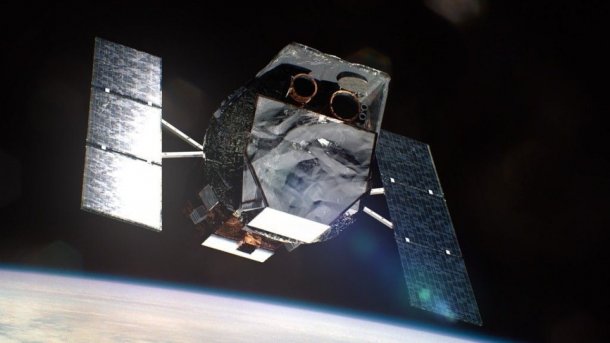
Artistic representation of the space telescope
(Image: NASA)
NASA has largely deactivated the Swift space telescope to slow its descent to Earth and extend its time in orbit. This has been done in preparation for a special mission, in which the instrument is to be pushed back into a higher orbit by a space probe so that it can conduct research there again. Until then, however, it must be prevented that the "Neil Gehrels Swift Observatory" descends too quickly and crashes before it can be rescued in this way. Therefore, since Wednesday, only one instrument has been activated, and the space telescope has stopped orienting itself towards new research targets. This would increase atmospheric drag too much, explains NASA.
Space telescope descending too quickly
The Neil Gehrels Swift Observatory was launched in 2004, at that time the instrument was only called Swift. The space telescope primarily investigates gamma-ray bursts, "the most powerful explosions in the universe," as NASA explains. On board are three different research instruments that operate in the visible, ultraviolet, X-ray, and gamma spectra. Of central importance is the Burst Alert Telescope (BAT), which covers about one-sixth of the sky at any given time and can detect gamma-ray bursts there. If one is detected, it can quickly orient the other instruments towards it and rotate itself. During its operation, the instrument has observed countless events. In 2018, it was renamed in honor of the research director who had recently passed away.
Videos by heise
Just in the fall, NASA made public that increased solar activity has caused the Earth's atmospheric fringes to slow Swift down more than originally expected. Without countermeasures, it would soon crash. To prevent this, NASA has paid a space company 30 million US dollars. In return, Katalyst is to raise Swift's orbit with its own spacecraft. This was supposed to happen in the spring of this year, but now the summer is being targeted. The cessation of research work is intended to ensure that Swift does not descend too much by then. Recently, it was traveling at an average altitude of less than 400 km. To prevent the space telescope from crashing, it must not descend below 300 km.


(mho)


