


The problem of cavitation: HAW Kiel starts project for quiet ship propellers
The noise from ship propellers disturbs the marine ecosystem. HAW Kiel investigated the cause and aims to develop quieter ship propellers.
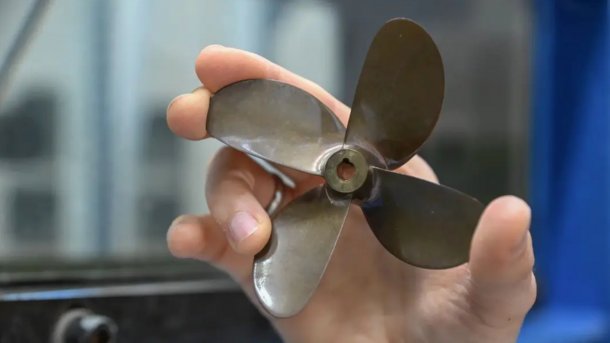
(Image: HAW Kiel)
The Kiel University of Applied Sciences (HAW Kiel) has started a research project dedicated to a problem that research has been grappling with for almost 20 years: the low-frequency underwater sound generated by ship propellers, which is responsible for underwater sound emissions in the oceans that can disturb marine ecosystems. In the project "Tools for Minimizing Sound Radiation from Cavitating Propellers" (MinKav), the scientists now aim to find a solution to the problem, as the university reported on Tuesday.
Imploding steam bubbles
In principle, the cause of the low-frequency noise from ship propellers is known. It is based on the physical phenomenon of cavitation. This involves the spontaneous evaporation of water due to a sharp drop in pressure on the suction side of a ship's propeller. Steam bubbles form, which implode when the pressure rises again, creating the noise.
The scientists at the Institute for Naval Architecture and Maritime Technology at HAW Kiel have already discovered details about this. In the cavitation tunnel of the Ship Hydrodynamics Laboratory, doctoral student Leonie Föhring determined the exact disintegration process of the steam bubbles on a smaller-scale propeller. Using an underwater microphone and a high-speed camera, she was able to make the cavitation audible and visible and gain initial insights: "The loud impulse occurs at the end of the bubble disintegration. Its loudness depends on how rapidly the process occurs."
In the next step, it will be investigated how the disintegration of the steam bubbles can be reduced and how a suitable ship propeller must be designed. While the noise can be reduced by a lower propeller speed, this is not effective. The scientists will now conduct flow simulations to test different propeller blades. Until now, reducing cavitation has not played a role in the design of such ship propellers. The focus is usually on performance, efficiency, and durability. The HAW Kiel researchers want to maintain these while simultaneously reducing sound emissions. Föhring clarifies the goal: "We want to combine species protection through noise reduction and climate protection through energy efficiency."
Influence on the marine ecosystem
The sound emissions caused by ship propellers can primarily disturb marine animals and negatively affect their lives. One example is whales, which use acoustic signals to communicate over long distances, orient themselves by sound, and thus also search for their food. The loud ship propellers due to increasing global shipping traffic in the oceans disrupt this communication and thus have a direct impact on the lives of whales. This, along with other man-made noise, such as that from military sonar and offshore wind farms, can lead to behavioral changes and health damage, and in the worst case, to panic and strandings in whales.
HAW Kiel also wants to implement the findings from its research and design a corresponding quiet ship propeller. Jasco-Shipconsult, a company specializing in ship and underwater acoustics and the design of ship propellers, is on board for this project to help translate research results into practice.
Videos by heise
The MinKav project started in early January 2026 and has a duration of three years. It is funded by the Schleswig-Holstein Business Development and Technology Transfer Corporation (WTSH) with a sum of 390,000 euros.



(olb)

