


Soon 100 social robots from Navel Robotics in use
Navel Robotics delivers the 100th social robot – it is intended to ensure a good mood and mental stimulation in care facilities.
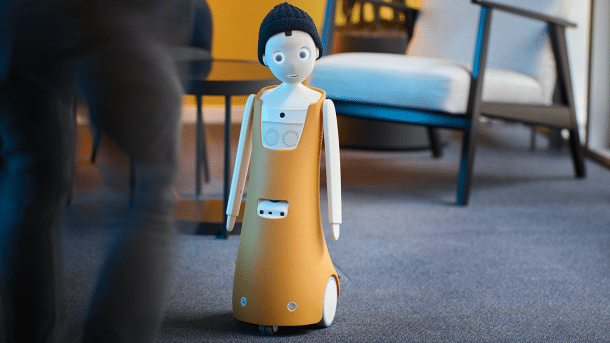
(Image: Navel Robotics)
The Munich-based start-up Navel Robotics will deliver its 100th social robot, "Navel," at the beginning of March 2026. The recipient is Seniorenhaus GmbH der Cellitinnen zur hl. Maria, which operates 24 senior care facilities between Kleve and Trier. According to the company, 100 Navel robots are now in daily use in residential care facilities. Care staff, as well as residents, regularly use the AI-powered systems. Navel is increasingly being used in other areas, such as with children for better language development, according to founder Claude Toussaint.
Studies and practical experience from pilot projects, including those with Hannover Medical School, TU Munich, and Evangelische Heimstiftung, suggest that social robots can promote cognitive and emotional activation and provide positive impulses for the mood in facilities. In facilities, it entertains with poems, jokes, and quizzes, acting empathetically. Prospectively, the robot is intended to move independently through the facility in the future and pick up residents for lunch, for example.
However, direct relief for personnel has not yet materialized according to past research projects, as the robot, in its current stage of development, usually requires supervision and does not yet act autonomously. "The biggest limitations were in response time, speech processing, and the lack of autonomous mobility," according to the final report from Evangelische Heimstiftung from 2024. Navel has since received several updates – for example, for facial recognition – and is intended to be able to approach people when they ask it to, for instance. Toussaint explained this to heise online in October 2025.
Videos by heise
Furthermore, the robot can create maps of the facility independently using SLAM technology (Simultaneous Localization and Mapping). This could allow the robot to navigate between rooms independently in the future, without needing to be carried or manually positioned. Toussaint also states that it should be possible to provide Navel with "further information about the target group and its task, as well as to adjust the speech tempo and response delay for the target group."
The company states that it focuses on data protection and European data sovereignty. Data is generally stored locally on the device, and parts of the AI processing occur directly on the robot, supplemented by European servers. The development is guided by the "Privacy by Design" principle, as well as the GDPR and the AI Regulation.
While the interest in social robots in the care sector is high, according to the manufacturer, "nevertheless, the Social Security Code XI currently prevents a faster spread of solutions because current regulations do not provide for the billing of such modern support systems," says Navel.


(mack)


