


"Good Luck, Have Fun, Don't Die": Fear of progress as a fever dream
We urgently need to turn off our phones. Because of all these feeds and because of AI. This isn't a proper analysis? At least it's enough for a movie.
(Image: Constantin Film)
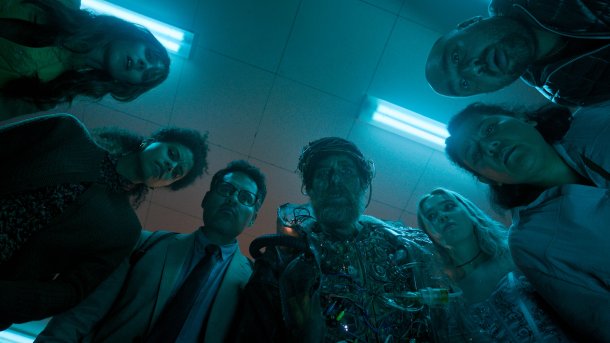
What do you put on an anti-hero when the tin foil hat is too cliché as a costume? Director Gore Verbinski chose something comfortable for his lead actor Sam Rockwell: a wool hat wrapped in a tangle of cables. Rockwell is good at making the human visible in shrill situations. Even under his cable hat, he maintains his dignity, a mischievous energy that drives the entire film “Good Luck, Have Fun, Don't Die”.

(Image: Constantin Film)
But he probably doesn't know what the hat is for himself. Does that even matter? “Good Luck, Have Fun, Don't Die” seems rather uninterested in technical gadgets. That's not always a problem. But if you're not precise about one thing, you won't have anything precise to say about it in the end.
A Groundhog Day at the Diner
As difficult as the plot of “Good Luck, Have Fun, Don't Die” is to grasp in detail, in principle it's quite simple: A man from a dystopian future bursts into a diner. He wants to prevent humanity from being subjugated by AI. To achieve this, the time traveler seeks the right team of random supporting actors among the restaurant's guests, with whom he can overcome all sorts of crazy obstacles in a wild ensemble romp. He has little time and no more patience; he has already gone through this time loop over 100 times.

(Image: Constantin Film)
Further details are rather glossed over; the film is long enough as it is. The goal of saving the world seems very close, yet impossibly far away, because new, improbable enemies can spawn at any moment. The fact that it only lasts for a handful of obstacles is due to the ensemble; in sweeping flashbacks, the supporting roles each experience a new aspect of the dawning dystopia. That takes time.
Videos by heise
On the one hand, the examples are sometimes funny and wild in themselves. On the other hand, they slow down the main plot. In any case, they don't lead to a common diagnosis. And they look strikingly like expensively equipped episodes of “Black Mirror”: what is told about voluntary reality loss, clones, Wi-Fi allergies, smombies, and addictive VR headsets is fast-paced, always has the next punchline in sight, and finds shrill, funny scenes.

(Image: Constantin Film)
However, few of them are new. Anyone who has seen “Groundhog Day” and “Pulp Fiction” in addition to “Black Mirror” will feel like they are in a time loop while watching. Occasionally, good visual gags or new ideas justify resorting to clichés, but very often they don't. The portrayal of mind-controlled teenagers glued to their phones as zombies seems particularly old-fashioned.

(Image: Constantin Film)
The Cart Stuck in the Mud
From the very beginning, “Good Luck, Have Fun, Don't Die” makes it clear what it's roughly about: The camera pans over the hands of people in a diner, and almost everyone has a phone in their hand, scrolling through a feed, maybe playing a shooter, but in any case, they don't look each other in the eye or are lying on a meadow.

(Image: Constantin Film)
This seems dramatic more because of the virtuosic camera work; it's not particularly exaggerated; it's true that people stare at their touchscreens for a significant part of their day. But tellingly, the film rarely focuses on what's happening on the screen. Social media, AI, games, some other place, probably the metaverse – everything is in this film on the phone, and it's all practically the same, all equally bad. Several times, there are scenes where these devilish devices are crushed or thrown into water.

(Image: Constantin Film)
This is one message of the film, but it has others too. For example, it's about a mother who lost her son in a school shooting and a society that no longer wants to acknowledge such a tragedy. It's already satisfied if the appearance of a perfect world can be quickly restored. As with the other vignettes, you see the punchline coming from afar, but you have to watch the film hammer home an overly obvious joke over several scenes unless you're looking at your phone at the same time.

(Image: Constantin Film)
The school shooting plot is at least shrill and works in its absurd exaggeration. The smombie story, on the other hand, seems sampled from a much older film. And the VR headset thing could pass as metaverse fanfiction. In the world of “Good Luck, Have Fun, Don't Die,” everything digital is addictive, entertaining, seamless, and so are data glasses that look strikingly like Meta Quest models. Tell-tale sign: The glasses work immediately, always have battery, don't need to be adjusted, and apparently don't leave pressure marks on the face. As soon as they are put on, people freeze in ecstasy; they are clearly experiencing a perfect future vision of virtual entertainment. But what is shown is more like New Age nonsense. The film doesn't really want to know what the glasses do.
With a certain disinterest, one watches all of this happen: always a lot, but so random, disparate, and unexplained that no tension arises. When people die, it's just another visual gag. Whether things end well or not doesn't matter. We're in a time loop, after all.
Put Down Your Phone!
If social media feeds, games, AI, and VR are all the same and all somehow represent a future where we only want to be distracted and entertained, then only platitudes remain.
“Good Luck, Have Fun, Don't Die” doesn't make the mistake of taking itself too seriously. It undermines its narrative and places some of its most delightful surprises when you're about to write the film off. That's why it works quite well as entertaining diversion. There are weak scenes and worn-out images, but they don't last long. And the next image could well be original.

But in this way, the film itself only produces casually fleeting distraction instead of commenting on it. Gore Verbinski apparently wishes that we would look up from the screen and perceive reality. In part, he's right, in part he's not. He could have been a little interested in what exactly people are seeing on the screen and how they interact with it. The fact that he hardly does condemns the film to an old-fashioned gesture of protest: Turn it off, this crap.
You can do that. That may help in certain situations, but not in many. For example, the film has no idea how to actually combat the threat posed by a seductive AI sketched out in the film. Instead, it's afraid of VR headsets.


(mack)

