


No scenario in which memory prices will correct in the second half of the year
Market researchers see no remedy for the current memory crisis. At least: The Iran war is not expected to have any major impact initially.
(Image: heise medien)
“There is no scenario in which memory prices will correct in the second half of the year, as the hyperscalers' purchasing intentions remain unbroken.” This is the conclusion reached by market researcher Counterpoint Research, which has contacts in the memory industry.
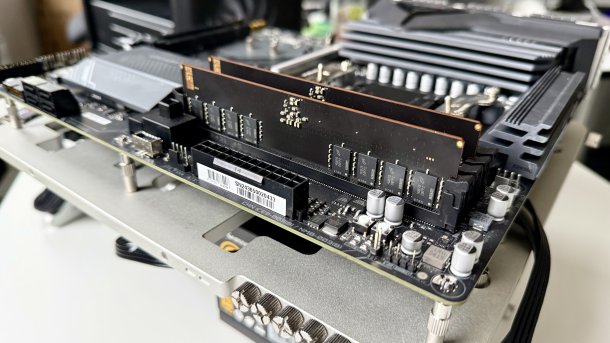
Counterpoint estimates that Samsung, SK Hynix, Micron from the USA, and the comparatively small competitors CXMT from China and Nanya from Taiwan will increase DRAM production by 26 percent by 2026. DRAM is available, for example, in the form of DDR5 RAM for desktop PCs, LPDDR5X for notebooks, and High Bandwidth Memory (HBM) for AI accelerators. NAND flash production for SSDs is expected to increase by 24 percent.
New semiconductor plants necessary
However, this is not enough to meet the high demand, which is primarily driven by cloud hyperscalers with their AI data centers. Memory manufacturers are primarily increasing production this year through more modern manufacturing processes, which allow more or more densely packed memory chips to fit onto a silicon wafer.
New semiconductor plants require time before they can produce memory modules in series. Even after construction is completed, it typically takes at least another six months before production can start. It then takes several more months for finished memory modules to be produced from a wafer.

According to a report by Business Korea, market researchers also conclude: An improvement in the memory crisis is not expected until the end of 2027.
No immediate helium catastrophe
Meanwhile, Counterpoint does not expect any immediate impact from the Iran war. It was temporarily unclear how long South Korea could manage without helium from the Middle East, as Qatar, the world's second-largest supplier, had stopped its exports as a result of the war. Helium is important for cooling silicon wafers in chip production, among other things.
Videos by heise
The news agency Nikkei Asia reports customs data showing that South Korean companies imported around two-thirds of their helium needs from Qatar in 2025. According to several reports, SK Hynix is said to have enough reserves for six months and has since better diversified its supply chain.
Meanwhile, the South Korean Ministry of Trade, Industry and Resources is said to have initiated investigations into how the country could decouple from the Middle East for 14 materials.
Empfohlener redaktioneller Inhalt
Mit Ihrer Zustimmung wird hier ein externer Preisvergleich (heise Preisvergleich) geladen.
Ich bin damit einverstanden, dass mir externe Inhalte angezeigt werden. Damit können personenbezogene Daten an Drittplattformen (heise Preisvergleich) übermittelt werden. Mehr dazu in unserer Datenschutzerklärung.


(mma)

