


Sale and the rescue of the beautiful image – the photo news of the week
A British county sells off a significant photo archive, debates about technology versus art, and the market rewards the imperfect precisely.
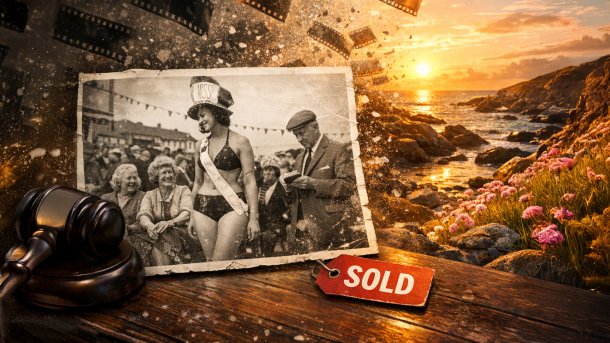
(Image: erstellt mit KI / Thomas Hoffmann)
There are weeks when the photography world is primarily concerned with itself – and in a way that is worthwhile. No new cameras, no firmware updates, but several debates that shake the foundations: What is a photo worth? What makes a photo art? And is it okay for an image to simply be beautiful without anyone feeling ashamed of it? Let's start with the most annoying part.
Kent Sells Tony Ray-Jones Archive – Historians Appalled
When a British local authority sells art, it's rarely a good sign. The fact that Kent County Council has now auctioned off 33 photographs by Tony Ray-Jones is, however, more than just an administrative act – it is a cultural loss. Ray-Jones is considered one of the most important British photographers of the post-war era. With his Leica M, sometimes hidden in a raincoat, he documented everyday English life in the late 1960s: beauty contests in Margate, Dickens festivals in Broadstairs, May Queen celebrations in Chatham. His style – unposed, observational, with dry humor – influenced an entire generation, most notably Martin Parr.
Ray-Jones died in 1972 at the age of only 31. His book A Day Off was published posthumously and became a reference for British documentary photography. The fact that originals from this work have now gone under the hammer because the Council found “no suitable storage alternatives” and is under “considerable financial pressure” rightly causes outrage. Photo historian Michael Pritchard sums it up: the short-term financial gain comes at the long-term cultural cost to the people of Kent. Particularly poignant: the pictures were not offered to a single museum or gallery in the region. One wonders if the responsible official even knew what he was giving away – or if the photos were simply “old pictures in the basement” to him.
Technical Perfection is Not Art – Or Is It?
While photographic history is being sold off cheaply in Kent, a debate is raging in the online photography world that is as old as digital photography itself, but feels surprisingly fresh again. Photographer Adam Matthews has published an essay that puts forward an uncomfortable thesis: many photographers mistake technical excellence for artistic expression. A perfectly exposed, razor-sharp mountain panorama in the morning light may be impressive – but it doesn't say much more than: “Look, a mountain in the morning light.”
Matthews distinguishes three categories: everyday photography (snapshots, souvenir photos, documentation), art photography (with an interpretive, expressive claim), and – this is his most interesting contribution – a third category he calls “technical vernacular photography.” This refers to images that go beyond snapshots because they are technically excellent, but still stick to description rather than interpretation. The photographer points to the world and says: “Isn't that incredible?” – with great skill, but no personal statement.
One can argue whether this tripartite division isn't a bit too neat for reality – one commentator dryly remarked that Matthews is stretching a basically simple realization into an elaborate theory. But the core hits home: anyone who invests their entire photographic development in better sensors, sharper lenses, and more perfect exposure may end up in a dead end that shines on Instagram but wouldn't hang in any gallery. And conversely: anyone who thinks art doesn't need technique is just as mistaken.
Authenticity is the New Premium
In line with this debate – and as a proof from the market economy, so to speak – Alex Cooke provides an analysis that is striking: In 2026, authenticity is the most commercially successful aesthetic in photography. Not despite, but because of the technical perfection that anyone can achieve today.
The logic is compelling: if AI-generated images are technically flawless and available almost free of charge, perfection ceases to be a distinguishing feature. What becomes scarce and therefore valuable is what AI cannot do: real presence in a real moment. Brands are now paying more for images that look as if they were taken with a disposable camera. Wedding couples book photographers who promise to stay out of the way rather than staging every scene. On stock platforms, search terms like “unfiltered” and “candid” are overtaking the classic “professional” and “studio.”
The irony: “Authentic” has long been a style that needs to be planned. Film grain that behaves like real film material. Slightly skewed compositions that signal presence. Motion blur as a deliberate design element. All of this requires at least as much skill as a perfectly lit studio portrait – only that the artistry must remain invisible. Going into a session with a Fujifilm X100VI or a Ricoh GR instead of a full-frame body with a battery grip and a 70-200mm on a monopod yields different images. Not because the camera is technically different, but because the social dynamic is different. The subject forgets they are being photographed. And that's precisely where the images that command premium prices today are created.
However, a commentator under the article reminded us that “authentic” remains a moving target: “Most people want to look natural and relaxed – but without real wrinkles, dark circles, and age spots, please.” Touché.
Praise for the Beautiful Image
And then there's a video by photographer Bergreen, which presents a refreshingly simple thesis: beautiful images deserve more respect. In a world that rewards edge, provocation, and conceptual weight, it actually takes courage to say: my camera is here to notice and preserve beauty. Not as decoration, not as escapism, but as a form of attention.
Bergreen describes photography as “gratitude in action” – a sunrise, wildflowers, light on a familiar rock. The more you look for beauty, the more you see it, and the images follow this attitude. The practical advice: go to a place that normally inspires you. Bring your camera, but leave it in your bag. First sit, walk, let the place have its effect. Then compose. This sounds almost meditative – and is perhaps exactly the counter-program to the hectic hunt for the next viral image.
Videos by heise
What Remains
This week shows that the most exciting developments in photography are currently not happening in data sheets, but in people's minds. An archive that disappears serves as a reminder that photographs are physical objects that need care and appreciation. The debate about technique and art shows that better cameras don't make better photographers – only better-equipped ones. And the trend towards authenticity proves that the market is sometimes smarter than the industry: what counts is not the perfect image, but the true one.
In that spirit: Feel free to leave the camera in your bag occasionally. Look first. And when the light moves across the rocks – then you're ready.



(tho)

