


Genetically modified bacteria convert plastic waste into Parkinson's drug
Old PET plastic packaging gets a second life through genetically engineered bacteria – as L-DOPA for Parkinson's patients.
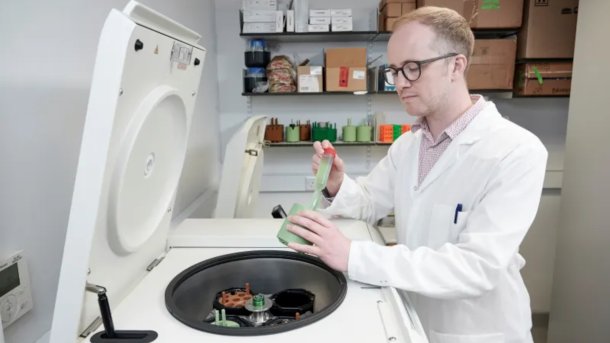
Professor Stephen Wallace of the University of Edinburgh extracts genetically modified bacteria.
(Image: Edinburgh Innovations)
Scientists at the University of Edinburgh have developed a biological process to convert PET plastics from food and beverage packaging into a medication for dopamine replacement therapy for Parkinson's disease. The researchers used genetically engineered "E. coli" bacteria for this purpose.
The process developed by the Scottish scientists uses lightweight packaging made of polyethylene terephthalate (PET) as the base material. The plastic is available in large quantities. Although the packaging often enters the recycling loop, it frequently ends up in landfills. Worldwide, about 50 million tons of PET are produced annually.
The researchers have set themselves the task of reusing this plastic waste and making something meaningful out of it. They wanted to create a life-saving medication from it, thus offering an alternative to conventional methods of pharmaceutical production based on crude oil, as they write in the study „Microbial upcycling of plastic waste to levodopa“, which was published in "Nature sustainability".
From PET plastic to Parkinson's medication
The process developed by the scientists begins with the breakdown of plastic waste into its main component, terephthalic acid, as a raw material. Genetically engineered "E. coli" bacteria then ensure that the carbon molecules of the acid are rearranged. Using these "programmed" biological reactions, the bacteria synthesize L-DOPA (also known as levodopa), a precursor of the neurotransmitter dopamine, from the fragments. The active ingredient is used to treat Parkinson's disease and restless legs syndrome (RLS). It is used as a dopamine substitute because it is converted into dopamine in the brain of Parkinson's patients by the enzyme Dopa-decarboxylase (DDC).
The scientists view their method as an example of how plastic waste can be reused with the help of biotechnology. The researchers assume that there are countless other possibilities for using plastic-degrading bacteria – for example, in the production of perfumes, flavors, and industrial dyes. The researchers at the University of Edinburgh had already applied the method to produce the painkiller paracetamol.
Videos by heise
The scientists are now working on accelerating the conversion process by the bacteria. This is intended to increase yield and make the process more cost-effective. So far, the process has only been tested on a laboratory scale. The next step is to scale it up to an industrial level.



(olb)

