


„Crimson Desert“ Played: The Adult Zelda Requires Strong Nerves
"Crimson Desert" is building great expectations among many open-world fans. However, after around 50 hours of gameplay, the picture is mixed.

How much substance is behind the epic trailers for the open-world adventure "Crimson Desert"?
(Image: Pearl Abyss (Screenshot: joe))
More than 360,000 pre-orders and over two million wish list entries on Steam alone: “Crimson Desert” is undoubtedly one of the most anticipated video games of the year. The hype is gigantic, and many expect nothing less than the ultimate single-player game. But can a game live up to such high expectations? Pearl Abyss, previously known mainly as an MMO developer, has created a real monster. An open-world chimera that tries to unite all previous genre representatives – for better or for worse.
The 100-Hour Game
“Crimson Desert” is an open-world action-adventure with pre-defined characters and can best be described as a mix between “Zelda: Breath of the Wild” and “Assassin’s Creed Valhalla” – as imaginative and adventurous as Link, as brutal and action-packed as Eivor. The flat fantasy story about a chosen one with superhuman abilities, like in the open-world veteran “Skyrim,” merely serves as a framework for exploring a gigantic continent.
Players will encounter various factions, numerous monsters and mythical creatures, underground tunnel systems, hidden treasures, a mysterious world above the clouds, as well as plenty of side quests and activities to pass the time. According to the developers, anyone who wants to experience everything will need well over 100 hours. But it remains to be seen how many players will last that long.
Crimson Desert (6 Bilder)
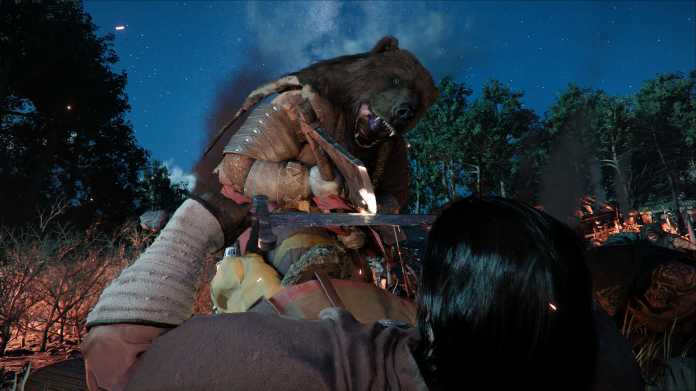
Pearl Abyss (Screenshots: joe)
)Many Small Frustrations
The open world of the fictional continent of Pywel exerts a frustrating fascination. On the one hand, you just don't want to put the controller down because a small adventure awaits behind every hill. On the other hand, the controller reliably flies through the living room once per quest because some design decisions drive the eager adventurer to madness. This starts with an unchangeable, completely overloaded button assignment that ignores all common patterns and ends with extremely frustrating boss fights, illogical puzzles, and confusing task descriptions.
In the first few hours of gameplay, “Crimson Desert” is a prime example of flawed quest design and feels like a compilation of the most unpopular open-world quests of the last 20 years. Some quest lines essential for progress are so trivial and uninteresting that you almost march through the game world on autopilot. Fetch quests are strung together without any connection. Nothing emerges organically from the experience, and the story takes a whopping four chapters to build any kind of tension for the first time.
A World for Adventurers
However, those who are not deterred by uninspired quest lines and lack of accessibility will be rewarded. Graphically and atmospherically, Pywel is a real experience. People, animals, insects, and moody mythical creatures teem everywhere. The densely overgrown forests move rhythmically in the wind, leaves swirl through the air, and the camera lens refracts the light perfectly. You constantly wonder in disbelief how all these many small details are technically possible.

In hardly any other game does the view of the seemingly infinitely wide horizon encourage exploration as much as in “Crimson Desert.” While this isn't always rewarding, stumbling upon a village full of childlike forest spirits while galloping through the woods, climbing on a gigantic tree creature, or accidentally falling into an underground cave system makes the adventurer's heart sing.
But even here, Pearl Abyss trips over its feet. The paths through the mountainous terrain are too often unnecessarily long and convoluted, and the sparsely populated network of too-well-hidden fast travel points strains the patience. Particularly annoying: precisely to your camp, the hub of many quest lines, there is no such fast travel point, and it can only be unlocked through a long-chaining puzzle.
More Action, Less RPG
“Crimson Desert” is not a complex role-playing game. Instead of a class system or an extensive skill system that fine-tunes attributes down to the decimal places, players unlock abilities directly. These expand the attack and movement variations in a meaningful way. Experience points are not automatically awarded through progress but through artifacts hidden behind puzzles or given as quest rewards. Weapons and equipment also influence the character's abilities and attributes. Compared to many competing titles, however, new items are rather rare and therefore feel all the more rewarding.
Videos by heise
This simple but effective focus directly contributes to “Crimson Desert's” biggest gameplay advantage: the combat system. Once you get used to the unconventional button mapping, you'll tear through hordes of enemies. The hit feedback is powerful, and perfectly timed counters and attack chains feel enormously satisfying, even reducing the environment to rubble. But here too, there are pros and cons. The carnage is accompanied by an impressive barrage of effects, which, however, sometimes kicks up almost too many sparks and leaves. In combination with sometimes wild camera movements, it becomes difficult to maintain an overview in battles against large enemy groups.
Unfortunately, the advantages of the combat system rarely carry over to the boss fights. Although Pearl Abyss strives for a lot of variety, grand staging, and a tough difficulty level, it rarely reaches the great role models like “Elden Ring,” “Black Myth: Wukong,” “Dragon’s Dogma 2” or “Shadow of the Colossus.” The bosses are far too often difficult to read; their attacks are downright unfair and not tailored to the movement and dynamics of your character. The rewarding feeling of success after a great challenge is usually overshadowed by many small moments of frustration. It is also unfortunate that most boss fights can be easily overcome by simply stocking up on enough food for health regeneration before the fight.
Empfohlener redaktioneller Inhalt
Mit Ihrer Zustimmung wird hier ein externes YouTube-Video (Google Ireland Limited) geladen.
Ich bin damit einverstanden, dass mir externe Inhalte angezeigt werden. Damit können personenbezogene Daten an Drittplattformen (Google Ireland Limited) übermittelt werden. Mehr dazu in unserer Datenschutzerklärung.
Interim Conclusion
“Crimson Desert” has the makings of a mega-hit. With its level of detail, structure, and many secrets, this open world is one of the most fascinating game worlds of recent years. Those who take the time and have enough patience, frustration tolerance, and curiosity can experience their very own adventure off the beaten path, full of magical moments, brutal combat, tricky treasure hunts, and overwhelming viewpoints.
However, there are many open issues on the negative side that sustainably dampen the fun: poor balancing, fiddly inventory management, lack of accessibility, overloaded controls, long travel distances, unnecessarily complicated puzzles, frustrating boss fights, many dull quest lines, bland characters, and a story that is not gripping for long stretches. Developers can fix small imperfections afterward, but narrative and structural problems will continue to gnaw at the motivation of many players.
Overall, the impression remains that “Crimson Desert,” despite the great hype, is not a game for the masses in its current state. Casual players will quickly reach their limits, and even experienced open-world fans will sooner or later resort to guides out of frustration to overcome some illogical or unfair parts of the game.
“Crimson Desert” will be released on March 19, 2026, for Windows, Playstation 5, and Xbox Series X/S for a price of just under 70 euros. The USK rating is 18 years. We played the PC version for this article.


(joe)

