


Wander-bot: Wind-powered robot to explore long distances without a battery
Wind is to power a robot on long-term missions, reminiscent of the "Strandbeesten". A turbine instead of a sail captures the wind.
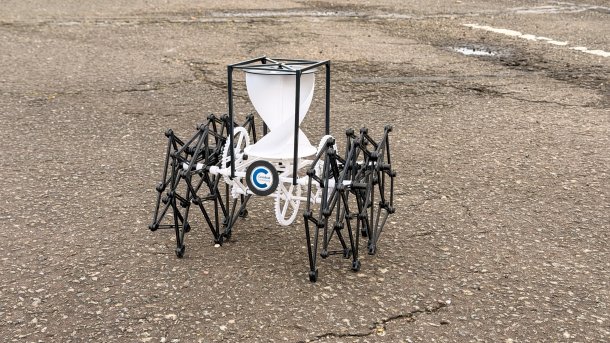
(Image: Cranefield University)
A research team at Cranfield University has developed a 3D-printed robot that moves forward using wind energy. The Wander-bot robot is inspired by Theo Jansen's “Strandbeesten” art project, in which the Dutch artist created wind-powered robots for the beach. However, the scientists' Wander-bot uses a wind turbine instead of sails for propulsion. This is intended to ensure that the robot can move better. The plan is to have the robot undertake long-term exploration tours in windy environments such as deserts or even on other planets without needing electricity for movement.
The Wander-bot is still in a very early stage of development and was presented as a low-maturity prototype at the European Space Agency's (ESA) Advanced Space Technologies in Robotics and Automation Symposium 2025 (ASTRA), as Cranfield University writes in a statement.
Empfohlener redaktioneller Inhalt
Mit Ihrer Zustimmung wird hier ein externes YouTube-Video (Google Ireland Limited) geladen.
Ich bin damit einverstanden, dass mir externe Inhalte angezeigt werden. Damit können personenbezogene Daten an Drittplattformen (Google Ireland Limited) übermittelt werden. Mehr dazu in unserer Datenschutzerklärung.
The robot essentially consists of parts created with a 3D printer. The Wander-bot uses a linkage mechanism for locomotion. The researchers draw on the linkage developed by Jansen, which converts rotational movements into walking movements. However, instead of sails, as used in Jansen's “Strandbeesten”, the researchers use a barrel-shaped Savonius wind turbine with scoop-shaped rotor blades. It is set in rotation by wind, which the researchers redirect via gears to the linkage, thus making the robot walk.
No motors or batteries needed for movement
According to the scientists, the Wander-bot should be able to walk autonomously when influenced by wind, without requiring additional energy. This means it is sufficient to install only a smaller battery in the robot to power additional electronics and sensors for environmental monitoring, for example. The robot's range is virtually unlimited due to wind energy propulsion and therefore not restricted by battery capacity. The Wander-bot can thus be used for very long periods in environments with a lot of wind. It can also be used where solar energy cannot be utilized due to lack of light or during darkness.
The robot benefits from being low-maintenance. It can operate for extended periods without human intervention in hard-to-reach locations, such as deserts and, prospectively, on other planets. Furthermore, the use of 3D-printed parts allows for quick and cost-effective repairs, the researchers promote the Wander-bot.
Videos by heise
The scientists are now working on improving the robot's maneuverability. It should then be able to move and be steered in more difficult terrain.
The research work of the scientists at Cranfield University is supported by the UK-RAS Network+ at the University of Manchester. Funding for the work comes from the UK Engineering and Physical Sciences Research Council (EPSRC).



(olb)

