


Researchers identify 45 exoplanets where life could be possible
Around 6100 exoplanets are known so far. Researchers have identified 45 on which life could be possible and which are well observable.
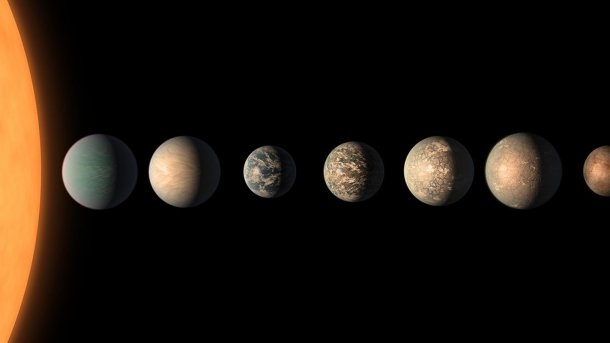
Artistic representation of the Trappist-1 star system with seven rocky planets.
(Image: NASA/JPL-Caltech (CC BY 4.0))
Is there life out there? The first exoplanets were discovered about 35 years ago. Since then, researchers have been searching for alien worlds similar to ours. A US research group has now compiled a list of known exoplanets that are considered life-friendly.
Currently, around 6100 exoplanets are known. Of these, about 220 are Earth-like rocky planets. The team led by Lisa Kaltenegger, director of the Carl Sagan Institute at Cornell University in Ithaca, New York, has identified 45 among them that lie in the habitable zone of their star. 24 of these also withstand a stricter interpretation of how much heat a planet can absorb. The team published its results in the journal Monthly Notices of the Royal Astronomical Society.

(Image: Gillis Lowry / Pablo Carlos Budassi (CC BY 4.0))
The habitable zone is defined as the region around a star where a planet has conditions that allow for life. This means it must be warm enough for water to exist in liquid form. This is the prerequisite for life as we know it.
Ten particularly promising candidates
According to the researchers, ten of the planets are considered particularly promising. These include Trappist-1e, one of seven rocky planets orbiting Trappist-1. Trappist-1 is a red dwarf star about 40 light-years away from Earth. Even closer are Wolf 1069 b, which orbits a red dwarf star 31 light-years away, and GJ 1061d, about twelve light-years away.

Finally, there is Proxima b, which orbits the star Proxima Centauri. The star Proxima Centauri is the closest to the Sun and only four light-years away. With future technology, this system could be reachable in a few decades.
"Our study shows where we should travel to find life if we ever build a Hail Mary spacecraft," said project leader Kaltenegger, alluding to the current science fiction film "The Astronaut - Project Hail Mary". "As Project Hail Mary so beautifully illustrates, life might be much more versatile than we currently imagine, so figuring out which of the 6,000 known exoplanets would be most likely to host extraterrestrials such as Astrophage and Taumoeba – or Rocky – could prove critical, and not just to Ryan Gosling."
Videos by heise
Where should we look?
The study was not only about identifying exoplanets that might harbor life, but also those that offer good conditions for closer observation. "While it's hard to say what makes something more likely to have life, identifying where to look is the first key step – so the goal of our project was to say 'here are the best targets for observation'," said team member Gillis Lowry.
These include, among others, Trappist-1e and its neighbors d, f, and g, or LHS 1140 b. These planets pass in front of their star and create spectral signatures in its light. This makes it possible to analyze their atmosphere and search for biosignatures.


(wpl)

