


Strong solar flare could affect moon mission
A solar flare has caused radio interference on Earth. The US space agency NASA is monitoring the situation due to the Artemis-2 moon mission.
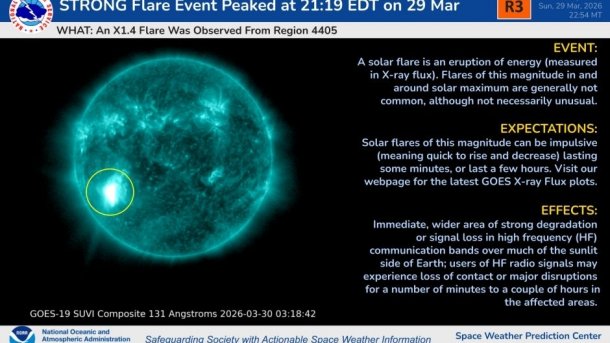
NOAA report on solar flare on March 30, 2026
(Image: NOAA)
A solar flare early Monday morning has led to radio system failures on Earth, according to the National Oceanic and Atmospheric Administration (NOAA). The event could also affect the planned launch of the Artemis-2 moon mission.
The X1.4 class eruption peaked at 5:19 AM our time on Monday, writes the Space Weather Prediction Center of the US Weather and Oceanographic Administration on its website. This led to "an R3 (Strong) Radio Blackout on the sunlit side of Earth." Widespread degradation of high-frequency (HF) communication occurred, "centered over the Maritime Continent, including Southeast Asia and Northern Australia."
The eruption occurred in sunspot region AR 4405. The very active region originated on the far side of the sun and is currently rotating towards Earth. Its activity in the coming days could therefore have an impact on Earth.
Artemis-2 is scheduled to launch on April 1
The Space Launch System (SLS) heavy-lift rocket is scheduled to launch with a four-person crew on board on April 1 at 6:24 PM Florida time (April 2, 00:24 AM our time). The ten-day mission is intended to bring humans near the moon for the first time since 1972. However, increased solar activity could endanger the mission.

The US space agency National Aeronautics and Space Administration (NASA) is therefore monitoring the situation very closely, wrote solar physicist Tamitha Skov via the microblogging service X. It is now important to watch for so-called Radio Bursts. These could affect high-frequency communication and satellite radio connections during launch and early maneuvers in orbit.
Videos by heise
The sunspot activity could provide a spectacular show in the sky in the coming days. According to the Working Group Meteors e. V., which deals with the observation of celestial phenomena, auroras could be visible in Germany on March 31 and April 1 due to the eruption.


(wpl)

