


Construction on world's largest wind turbine in Germany continues after problems
Construction of what will then likely be the tallest wind turbine had stalled due to quality issues with steel parts and is now continuing.
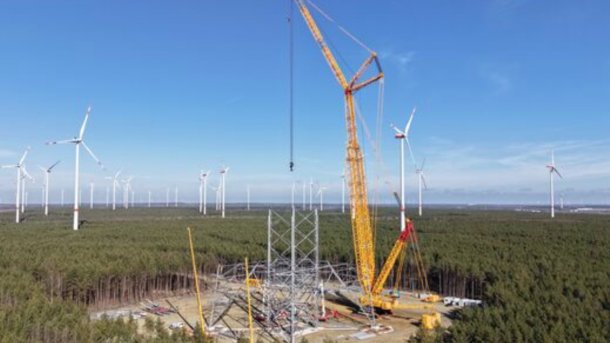
The construction site of the tall wind turbine in Lusatia.
(Image: GICON)
In Germany, specifically in Schipkau, Brandenburg in Lusatia, the world's largest wind turbine is being built. With a total height of 365 m and a hub height of 300 m, the tall wind tower is expected to generate between 30 and 33 GWh of electricity per year after completion. The above-ground construction work, which was halted during winter, has been resumed by the construction company GICON after a quality check of the components and partial replacement.
At the end of 2025, GICON discovered that a subcontractor had supplied steel components for the wind turbine that did not meet the required quality standards, as GICON announced in early March. GICON used the winter months to inspect already installed parts. Almost all replacement parts have now arrived, and the replacement of parts was completed by the end of March. Construction of the wind turbine will then continue with new parts. GICON also commissioned the large crane for the subsequent construction activities in February.
Cost-effective electricity production expected
The GICOM tall wind turbine is designed to utilize wind energy at high altitudes. Depending on the location, optimal conditions for the use of wind energy can prevail there. Winds there are generally stronger and more consistent, allowing for higher electricity yields annually. GICOM estimates that such wind turbines can generate between 30 and 33 GWh per year. This corresponds approximately to the annual consumption of 7,500 four-person households.
The consistently usable wind is expected to impact costs in addition to providing a reliable and more productive power supply. The levelized cost of electricity is expected to be less than 5 cents per kilowatt-hour.
Videos by heise
To bring the turbine nacelle to a height of 300 m, the engineers have devised something special: the construction is designed telescopically. The turbine is initially mounted at a height of 150 m. It will then be raised from there to its final position at an even higher altitude. Special “height-resistant” assembly workers are required for assembly at greater heights. However, there are none in Germany, so assemblers from Turkey will carry out these tasks.
According to the current status, it is still unclear when the construction work on the wind turbine, which began in July 2025, will be completed. This depends on the construction progress achieved in the coming months. In 2025, it was still stated that construction would be completed in the summer of 2026. However, GICOM remains committed to the tall wind turbine being connected to the grid by the end of 2026.



(olb)

