


AI chip start-ups: Most will disappear by 2030
The number of companies developing specialized AI processors is expected to shrink from 99 to just 25, predicts JPR.
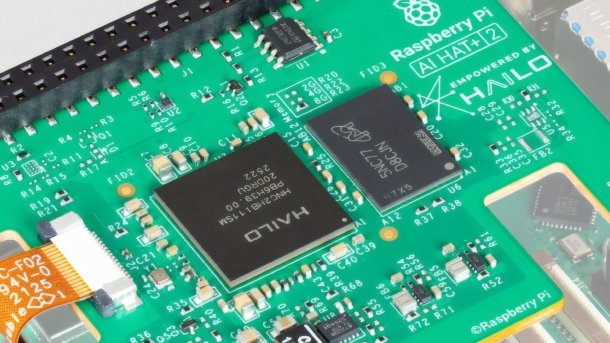
PCI-Express Module Raspberry PI AI HAT+ 2 with AI Processor Hailo-10H
(Image: Raspberry Pi)
The AI chip euphoria has already subsided somewhat, and many disappointments are looming in the medium term, according to market researchers at Jon Peddie Research. According to estimation models, investors have poured nearly 29 billion US dollars into the development of AI chips since 2000, often in start-up companies. However, most of them will soon disappear, predicts JPR.
For comparison, the market researchers point to the historical development of 3D graphics chips, of which only a very few companies develop today.
In the first quarter of 2026, Jon Peddie Research (JPR) counted a total of 135 companies developing AI processors. 36 of these are publicly traded companies such as Nvidia, AMD, Google, Amazon AWS, Qualcomm, Tesla, Meta, Microsoft, Broadcom, or Marvell.
Videos by heise
Majority of start-ups
The vast majority of AI chip developers, namely 99 companies, are start-ups. Most are working on specialized AI accelerators for specific applications or areas of use. Examples include Tenstorrent, Cerebras, SambaNova, Groq, Esperanto, Mythic, Hailo, Q.Ant, Taalas.
Some of these are aiming for IPOs, such as Cerebras and Hailo currently. Several have been acquired by other companies, such as Groq by Nvidia and Graphcore by SoftBank.
JPR expects that by 2030 – in four years – only about 25 developers of specialized AI chips will remain. "Many start-ups and their investors will be disappointed," estimates JPR CEO Dr. Jon Peddie. Nvidia's gigantic success attracts many companies and investors, but it is not easy to profit from the AI market.
Other experts point out that many AI development companies underestimate the effort required to provide competitive software that makes the potential of the respective chips practically usable in the first place.

Five market segments
JPR distinguishes five essential market segments for AI processors: AI training, AI inference in the cloud, AI on smartphones, tablets, notebooks, and PCs, AI in the Internet of Things (including toys, possibly also "Edge AI"), and autonomous systems such as robots and cars.
For these, the companies covered by JPR offer not only complete chips but also AI compute units in the form of IP cores (Intellectual Property Cores) for integration into other chips.
China is catching up
JPR emphasizes that the large Chinese market is increasingly decoupling because companies there, such as Alibaba, Baidu, Huawei, Cambricon, or Moore Threads, are developing their own chips. Consequently, US companies may sell fewer chips to China and face pressure from Chinese competitors in other countries.


(ciw)

