


Researchers develop electrofluidically powered muscles for quiet robots
Hydraulically powered robot actuators are typically noisy. The electrofluidic muscle from MIT Media Lab and Politecnico di Bari, however, operates silently.
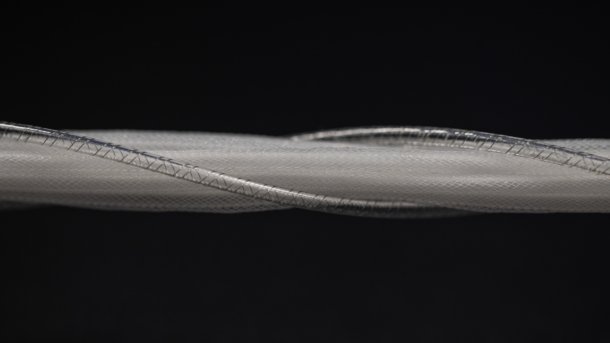
The artificial muscle consists of several muscle strands, which essentially are thin tubes in which a dielectric fluid moves.
(Image: Gabriele Pupillo, Ozgun Kilic Afsar)
A research team from MIT Media Lab and Politecnico di Bari in Italy has jointly developed an artificial electrofluidic muscle that can be used as a soft actuator in robots. The muscles are moved by pressure changes through pumps, operate quietly, and could thus enable quieter robots.
Artificial muscles in robot actuators are often powered by heavy hydraulic systems that cause loud operating noise. However, electrically powered artificial muscles that operate quietly are too weak to move the heavy limbs of humanoid robots sufficiently quickly.
Empfohlener redaktioneller Inhalt
Mit Ihrer Zustimmung wird hier ein externes YouTube-Video (Google Ireland Limited) geladen.
Ich bin damit einverstanden, dass mir externe Inhalte angezeigt werden. Damit können personenbezogene Daten an Drittplattformen (Google Ireland Limited) übermittelt werden. Mehr dazu in unserer Datenschutzerklärung.
The researchers from MIT Media Lab and Politecnico di Bari have developed electrofluidic artificial fiber muscles that can be bundled together. They operate quietly, are responsive, and are strong enough to power actuators for robots, the scientists write in the study “Electrofluidic fiber muscles,” which was published in Science Robotics.
The muscle system they developed is based on electrohydrodynamic principles. Individual muscle fibers consist of approximately 2 mm-thin tubes. They contain a dielectric fluid that has already been pre-filled under pressure in the closed system. This pressure can be specifically adjusted depending on the application. When a charge is introduced into the fluid via electrically driven pumps in the millimeter range, the resulting ions transport the fluid with them. This generates further pressure and flow, which move the artificial muscle fibers. They then operate silently and exhibit muscle-like performance with a reaction time of less than 0.3 seconds.
Specially arranged muscle strands for different applications
However, the individual muscle fibers must be specially arranged depending on the intended use. Additionally, counteracting muscle strands can be generated to create, for example, antagonistic muscles. Thus, a contracting biceps and an extending triceps can be built, similar to bending an arm. The researchers succeeded in creating different muscle configurations. For instance, they built muscles that could lift light objects at a reaction time of less than 0.3 seconds with a speed of 180 mm per second. In another configuration, the researchers realized a muscle that could lift a 4 kg object approximately 30 mm. This corresponds to about 400 times the weight of the artificial muscle used. A muscle woven from the muscle fibers could move a robotic arm at an angle of 40 degrees and generate enough force to replicate a human handshake.
Videos by heise
This pressure can be adjusted depending on the application. When a charge is introduced into the fluid via electrically driven pumps in the millimeter range, the resulting ions transport the fluid with them. This generates further pressure and flow, which move the artificial muscle fibers. They then operate silently and exhibit muscle-like performance with a reaction time of less than 0.3 seconds.


(olb)


