


Rokid brings two smart glasses to Germany
Today, the "Rokid Ai Glasses Neo" without a display and the "Rokid Glasses" with a display are launching in Germany. The glasses support ChatGPT and Gemini.
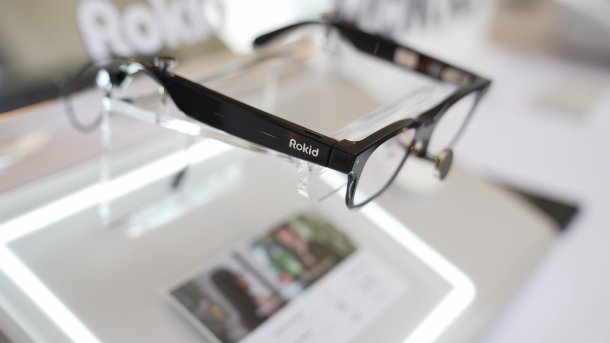
The Rokid Glasses with a display.
(Image: Rokid)
After the Chinese smart glasses manufacturer Rokid presented two different smart glasses at trade fairs this year and last year, the official sales launch of both devices in Germany takes place today.
The first device, the Rokid Ai Glasses Neo, dispenses with a display and positions itself as a competitor to the Ray-Ban Meta glasses in terms of technology and price. Like these, it relies on speakers, microphones, and a camera. The latter is said to enable 4K video recordings in various image formats.
The smart glasses are operated via voice commands in twelve languages, touch input, and head gestures. It supports translation in 89 languages. For people with visual impairments, corrective lenses up to ±15 diopters are offered. Thanks to a dual-chip design, the glasses are said to offer up to twelve hours of active use.
Videos by heise
Micro-LED display expands AI functions
The second device is the Rokid Glasses, which additionally feature a dual display based on Micro-LEDs and waveguide technology. According to Rokid, the digital display offers a field of view of 30 degrees, a resolution of 640 × 480 pixels, and a brightness of up to 1500 nits. Information appears in green, as with the Even Realities G2. Therefore, it can only be conditionally compared with the Meta Ray-Ban Display, which is currently only available in the USA and features a full-color display for the right eye.

(Image: Rokid)
However, the display also enables functions here that would not be possible in this form with display-less smart glasses, including, according to Rokid, visual navigation aids, translations and transcriptions, as well as a teleprompter function. Corrective lenses are not integrated into the Rokid Glasses but are attached to the glasses via separately available magnetic inserts.

Rokid glasses: prices and market environment
A special feature of the Rokid glasses is that they support two different AI models. Users can choose between ChatGPT from OpenAI and Gemini from Google.
The display-less Rokid Ai Glasses Neo cost 449 Euros, positioning them between the second-generation Ray-Ban Meta glasses (from 419 Euros) and the new Optics models (from 469 Euros), which are optimized for people with visual impairments and all-day use. The Rokid Glasses with a monochrome dual display are available from 699 Euros.
Rokid is entering a market dominated by Meta: the company sold seven million devices last year and, according to a recent study, holds over 80 percent market share. However, major competition is already on the horizon: the first smart glasses from Google and Samsung are expected this year, and Apple is also reportedly preparing corresponding devices, which could hit the market next year.


(olb)

