


Most important server CPU benchmark gets an update after 9 years
CPU designers are switching to the SPEC CPU 2026 benchmark. The new version even runs on a Raspberry Pi.

(Image: Andreas Wodrich / heise medien)
The Standard Performance Evaluation Corporation (SPEC) is updating its most important benchmark after nine years: Following SPEC CPU 2017, SPEC CPU 2026 is here with a completely revamped foundation. The underlying test grows from 43 to 52 sub-benchmarks.
Unlike other benchmarks like Cinebench or Geekbench, all SPEC CPU versions do not contain a ready-made installation file. The responsible consortium provides the source code, which testers must compile themselves. The idea behind this: This way, the test runs on all sorts of hardware and users can optimize the benchmark as they wish, for example, to utilize new CPU functions.
The most important CPU designers, server manufacturers, hyperscalers, and researchers are behind SPEC. Among them are AMD, Intel, Nvidia, ARM, Ampere, IBM, Microsoft, Oracle, Supermicro, HPE, Dell, Cisco, Lenovo, and SiFive.
SPEC CPU is widely used in the industry, also as a standard benchmark by AMD and Intel. Among private users, the suite occupies a niche existence because, in addition to compiling, operation via the command line is required.
New Test Suite
Like its predecessors, all sub-benchmarks of SPEC CPU 2026 come from the "real world." The consortium selects applications to include in its suite. Surprise: The rendering part with Blender is dropped without replacement, as is the x264 encoder for the H.264 video format. New additions include CPython, a FLAC audio encoder, and the SQLite database engine.
Teil-Benchmarks in SPEC CPU 2026 (3 Bilder)
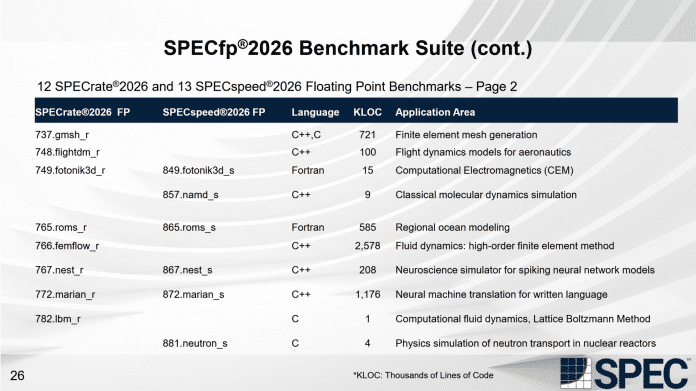
SPEC
)The Base run limits all 52 sub-benchmarks to a single compiler with the same flags. "Peak" allows compiler optimizations per sub-benchmark to maximize performance. Users must optimize in C, C++, and Fortran.
SPEC CPU 2026 can also utilize modern server processors with 128 CPU cores and more. Some of the integer tests are designed to explicitly overload the processor front-end with many instructions, which translates the commands and then distributes them to the execution units.
The test suite now also explicitly includes single-board computers like Raspberry Pis and RISC-V processors. The official database lists results with the Raspi 5 16 GByte, for example (with obviously few points).
Videos by heise
Many Threads Need Lots of RAM
Each running instance requires 2 GByte of RAM. Therefore, to utilize a modern desktop processor like AMD's Ryzen 9 9950X3D2 with 32 threads, 64 GByte of RAM is needed. A 128-core processor with 256 threads requires 512 GByte.
A license for SPEC CPU 2026 costs $3000 USD by default. Upgraders from the 2017 version pay $2000 USD (limited until November 3, 2026). Non-profit organizations pay $750 USD. Accredited universities and colleges receive the license free of charge.
Empfohlener redaktioneller Inhalt
Mit Ihrer Zustimmung wird hier ein externer Preisvergleich (heise Preisvergleich) geladen.
Ich bin damit einverstanden, dass mir externe Inhalte angezeigt werden. Damit können personenbezogene Daten an Drittplattformen (heise Preisvergleich) übermittelt werden. Mehr dazu in unserer Datenschutzerklärung.


(mma)


