


Anonymizing Linux: Tails 7.8 makes Thunderbird an add-on
The Linux Tails 7.8, intended for anonymous web browsing, closes several kernel vulnerabilities and makes Thunderbird an add-on.
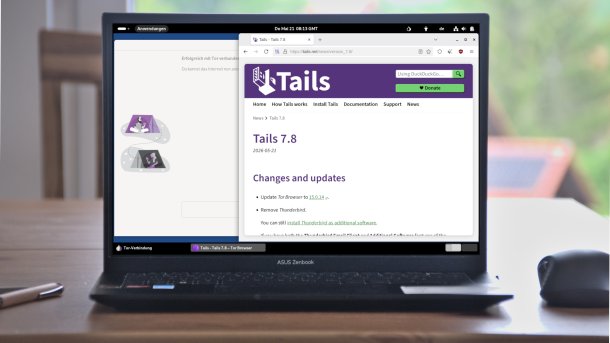
(Image: heise medien)
The anonymizing Linux distribution Tails closes the recently discovered kernel vulnerabilities in its new version 7.8. Furthermore, it removes Thunderbird from the base and now offers the email program only as add-on software.
In the release announcement, the Tails developers write that they are now outsourcing Thunderbird as announced. With the release of Tails 7.5 at the end of February, it was stated that Thunderbird would be installed as add-on software in the future to improve security. Those interested must activate the functions “Additional Software” and “Thunderbird Email Client” in the persistent storage. Thunderbird will then be reinstalled from the persistent storage with each start of Tails.
This is intended to help with the problem that because of the Thunderbird release schedule, the email client was always included in an outdated version shortly after the release of a new Tails version, which was also riddled with security vulnerabilities. In the persistent storage, the package can be quickly updated for installation, which Tails does automatically. A dialog called “Thunderbird Migration” after installation is intended to simplify the transition. The email program will thus be removed from the list of standard software in Tails.
Videos by heise
Further changes in Tails
The Tails 7.8 release also patches further kernel vulnerabilities, after the emergency update to Tails 7.7.3 already fixed the DirtyFrag privilege escalation vulnerability in the Linux kernel last week. This includes, e.g., the Fragnesia vulnerability (CVE-2026-46300, CVSS 7.8, risk “high”). Furthermore, the update prevents a sandbox escape from Flatpaks using Yelp. The Tor Browser is included in version 15.0.14, which is based on Firefox ESR 140.11, which in turn closes several security vulnerabilities.
The current version is available as an image for USB sticks, which can then be used to boot foreign computers and navigate the web without leaving incriminating traces or bypassing censorship measures. An ISO image for burning to DVD or for booting in a VM is also available.


(dmk)


