


Exoplanet LP 890-9c: Probably particularly life-friendly super-Earth discovered
The star LP 890-9, 100 light years away, is orbited by two exoplanets. One of them could have particularly life-friendly conditions.
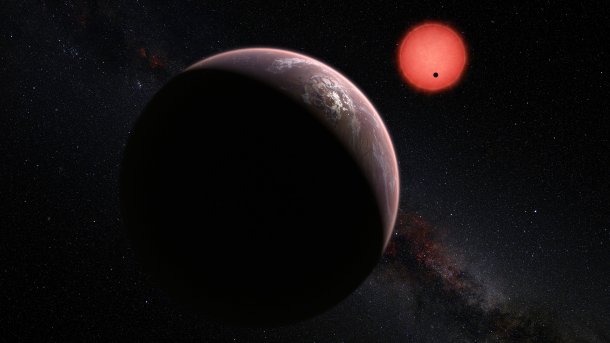
(Bild: ESO/M. Kornmesser/N. Risinger (skysurvey.org))
(Hier finden Sie die deutsche Version des Beitrags)
An international research team has discovered two so-called "super-Earths", one of which could offer comparatively favourable conditions for Earth-like life. This is what the group, led by Laetitia Delrez from the University of Liège, explains. The inner of the two exoplanets, named LP 890-9b and TOI-4306b respectively, was found by the TESS space telescope. During follow-up observations with the SPECULOOS instrument (Search for habitable Planets EClipsing ULtra-cOOl Stars), the much more exciting outer neighbour LP 890-9c was found. The team believes that it could be as life-friendly as the famous exoplanets in the TRAPPIST system or even surpass them.
Particularly well suited for further research
According to the analyses, both exoplanets in the system, which is about 100 light years away, have radii of about 8,500 km, which makes them about 40 % larger than Earth. They orbit a comparatively small and cold star, only one even colder star has been found so far - TRAPPIST. The research team writes that both orbit the star quite closely, but still receive very little radiation. Exoplanets in this environment are particularly well suited for analyses of the atmospheres and the search for possible traces of life.
Videos by heise

(Bild: Adeline Deward (RISE-Illustration))
Although the distance of the outer of the two exoplanets to its star still corresponds to one tenth of that of Mercury to the Sun, it is thus located at the inner limit of its habitable zone. Liquid water could therefore exist on its surface and thus conditions that led to the emergence of life on Earth. The conditions could be even more favourable than the data suggest, the team believes. They have published their work in the journal Astronomy & Astrophysics.
The data are a justification for further exploration of the exoplanet, at best with the James Webb space telescope, the team writes. When it comes to the precise delineation of the habitable zone, models differ, and the discovery of LP 890-9c opens up a unique opportunity to better understand "the conditions for habitability around the smallest and coldest stars in our Sun's neighbourhood". Among the Earth-like exoplanets found so far that could harbour life, only those around TRAPPIST seemed to offer even more favourable conditions than LP 890-9c.
Empfohlener redaktioneller Inhalt
Mit Ihrer Zustimmung wird hier ein externer Inhalt geladen.
Ich bin damit einverstanden, dass mir externe Inhalte angezeigt werden. Damit können personenbezogene Daten an Drittplattformen übermittelt werden. Mehr dazu in unserer Datenschutzerklärung.
An interactive graphic is embedded in the article, which is created and delivered by the Berlin-based service provider Datawrapper. For Datawrapper's privacy policy, see their privacy policy. Personal or personally identifiable data of readers of the interactive charts is not collected.


(mho)


