


Interview on offshore wind power: "It's a huge challenge".
Offshore wind power is to be massively expanded in the coming years. State Secretary Stefan Wenzel from the BMWK explains how this can work.
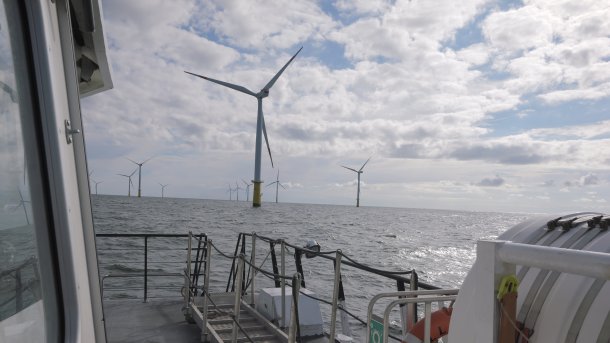
(Bild: heise online/Johannes Börnsen)
(Hier finden Sie die deutsche Version des Beitrags)
This interview is part of a series of articles on the German expansion of offshore wind power. The series comprises several parts, which we will publish from Tuesday to Friday this week. Click here for the first part: Ways to energy independence - offshore wind power
On 14 September, heise online was able to talk to Stefan Wenzel from the Federal Ministry of Economics about the situation of offshore wind power in Germany.
Mr Wenzel, you are Parliamentary State Secretary in the Federal Ministry of Economics and Technology and are jointly responsible for energy and climate policy. You have just been to Dublin to discuss with riparian states how offshore wind power can be expanded. What exactly was discussed there?
Yes, I represented Federal Minister of Economics Robert Habeck in Dublin. The North Sea riparians met there, the "North Seas Energy Cooperation". In addition to the direct riparians, Ireland, France and Sweden are also represented. In Dublin, intensive discussions were held on how to jointly expand offshore wind power and what steps are necessary to achieve good networking here, i.e. to strengthen electricity transport between the littoral states as well and thus make a strong contribution to energy supply.
The traffic light government has issued new offshore expansion targets. They have been increased to 30 gigawatts by 2030, 40 gigawatts by 2035 and at least 70 gigawatts in 2045. All of this is to be developed via offshore wind power in Germany. We are currently at 7.8 gigawatts. How, for example, is the first leap to 30 gigawatts by 2030 to be achieved?
Offshore wind power is still a relatively new technology. Germany is far ahead in terms of expansion, the UK is still a bit further ahead in terms of quantity. In Germany, however, there has unfortunately been a slump again in recent years. Last year and this year, almost no projects will be realised. This is due to the fact that the tenders were very patchy and now there is almost a break in the thread again.
That is why it is in the great interest of all the riparian states to initiate a continuous development here, which will also make it possible to advance the entire framework conditions that are necessary to realise such a technology.
In Dublin, we also spoke with various industry representatives about capacities, planning times, lead times, supply chains, and the question of how to strengthen production capacities in Europe. It often takes long lead times and that is a huge challenge - especially for smaller countries.
It is important here to seek cooperation with the neighbours. A hybrid connection is therefore planned. Each wind farm would then have two connections. This means, for example, that a wind farm on Bornholm would have one connection to Denmark and one to Germany. This would create a network that would make it possible to better use wind power in different regions of Northern Europe and strengthen the security of supply with renewable electricity.

Many suppliers to the wind power industry have gone bankrupt in recent years. Do they also want to work with subsidies to rebuild this industry?
First of all, it should provide orientation on what is planned for the next ten, twenty and thirty years. The members of the North Seas Energy Cooperation, which includes the European Commission as co-chair, are planning a total of 260 gigawatts of offshore wind. This includes the western coast of France. And there arises a problem that could be called the chicken-and-egg problem.
What company builds submarine cables if it doesn't know whether it will have a customer who needs the cable in three or four years' time? In this respect, the first intention is to create more reliability and transparency here, to make it clear to the players on the market what the public sector is planning and at what rhythm there will be tenders. The conditions under which these tenders will take place are also important. And there can certainly also be steps aimed directly at strengthening Europe's energy sovereignty as a whole and ensuring that important suppliers can also settle or be kept in Europe.
You want to ensure more planning security. In terms of approval procedures, the Ministry of Economics is now focusing on streamlining processes, including at the Federal Maritime and Hydrographic Agency (BSH), which is responsible for checking areas and seeing whether they can be designated at all. However, the BSH is not directly assigned to the Federal Ministry of Economics, but is a division of the Ministry of Transport and Digital Affairs. How do you actually intend to streamline these processes if they are not part of your portfolio?
The federal government usually works very cooperatively on such central issues. The houses also support each other. For example, we also need an efficient port infrastructure. We need quay walls that can withstand enormous weights. Or what has also turned out, for example: It is not at all easy to get the supply ships and the erector ships. There are only a few shipyards that have specialised in this area so far, and even they need time to prepare. When an order is received there today, it takes three or four years until the ship is finally at the location and the crew is trained. That is why many different players are involved and why we want to cooperate well with the Ministry of Transport.
So do you think it's not so bad that the processes and approval process take so long with us because the producers have problems anyway?
No, not that. We want to speed up the whole approval process as much as possible. This is an important point, both on land and at sea. Shortly before the summer holidays, the Bundestag amended the "Wind on Land Act" and the "Wind at Sea Act". The Nature Conservation Act was also tackled in order to be able to more reliably observe the requirements in the area of nature conservation.
The tender criteria are still being discussed in order to achieve the best possible and fastest possible results. And in Dublin there was really a great deal of dynamism, a great will to work together across borders here as well. I was very pleased about that.
Videos by heise
With the amendment, the type of area tendering at the Federal Network Agency was also changed. There is now an auction system, as known from mobile radio licences. The highest price for the rights to use the site will now be decisive. The "Stiftung Offshore Windenergie" (Offshore Wind Energy Foundation) has harshly criticised this: "It doesn't work like that, you have to adapt it or delete it, because otherwise everyone who actually wants to build something will be driven away.
In addition to the monetary component, there should also be qualitative criteria that decide on an award. For example: Is it produced nearby? Is it recyclable? Steel qualities could also be taken into account. In fact, there are reservations about the financial component. After the first tender, we will evaluate the experiences. Of course, we want to make sure that investments are made then.
Why did they move away from the old regulation in the first place?
I would have to check that.
But how much does the amendment restrict nature conservation? At the moment, the preliminary surveys look at what flora and fauna there are, when breeding seasons are, where feeding grounds are. This is usually checked over longer periods of time, often over two years, to find out exactly where animals are and what they are doing there. So is it possible to make any deletions at all in these surveys? Can you quickly say: "This part of the North Sea is not that important for the ecology of the whole sea"?
No, this will be taken very seriously. In the North Sea, we see very different uses. We have areas where raw materials are mined, we have areas that are used for military purposes. We have areas that are used by shipping. And we also have areas that are reserved for nature conservation and are not used for wind power. And in this context, there was a discussion in the Bundestag about the amount of land needed, because the environmental associations said: If more than 58 gigawatts were built, there would be a serious conflict with nature conservation.
In the North Sea, however, there are also a lot of transport areas that could possibly be redesigned. If you look at the map, you will see that optimisation is certainly possible. After all these years, we should also discuss the mining of raw materials: What is still needed? Who uses it? These are questions that must be asked in the spatial planning process. This is also in the interest of all countries bordering the North Sea.
If, for example, we also look at the environmental impacts during the construction period of parks, we can also examine alternatives and new technical options. For example, to reduce noise during pile driving.
But of course there are also important points where these two issues - expansion and environmental protection - support each other. For example, when we see how the acidification of the oceans has accelerated in recent years, we realise that this acidification can only be reduced by switching to renewable energies. The switch therefore also directly serves marine protection, because acidification affects all living creatures, especially those that have shells or calcium carbonate skeletons.
John Kerry, the US climate protection commissioner, recently pointed out that there are already signs that the amount of oxygen-producing organisms in the ocean is decreasing. And this may be related to changes in temperature or pH as measures of acidification, for example. We must continue to press ahead with climate protection at full speed. The oceans play a very central role in this. In this respect, we are faced with the challenge of ensuring climate protection, as climate change has a massive impact on our biosphere and especially our oceans. However, we must always keep an eye on local biodiversity in all construction measures. There was also a separate working group on this in Dublin.
What is planned for the German Bight? Has there been any talk about floating wind farms, for example? They would reduce the amount of work in the sea. Norway wants to use such parks.
Norway is definitely planning pilot projects with "floating offshore" - i.e. floating wind turbines. France is also moving in this direction. All countries that have coasts where the water depth is very high see this as an option for themselves. Siemens Gamesa has a plant in Cuxhaven on the German North Sea coast, and that is also the lead plant for floating offshore. So this will increasingly play a role worldwide. I believe that floating offshore can play a very important role in the future.
What is the situation in the Baltic Sea? Offshore development in the Baltic Sea is not that strong, at least not in the German part. Should there be any further expansion at all, because the Baltic Sea in particular has major ecological problems?
There is a joint project with Denmark in the Baltic Sea. The plan is to use Bornholm as an energy island and to create a hybrid connection, i.e. to build a connection line to Germany, Mecklenburg-Western Pomerania and another to Denmark. In principle, I am of the opinion that the expansion of renewable energies - including offshore wind power - also helps marine protection in the end.
Do you know of any research results that say: Nature conservation is also possible in a wind farm, or that new ecosystems are also created there?
Yes, there is also this discussion. This must be monitored further, because in a wind farm like this, fishing is restricted or no longer takes place at all. Fishing can also have a massive impact on marine flora and fauna through overfishing. Wind farms may therefore also create quiet zones.
For shipping, by the way, damage must be limited here. Here, too, climate targets must be met. Up to now, practically all the waste from the world's refineries has been burnt on the seas. Practically all the waste from the refineries goes into the heavy ship engines. The limit values there are defined quite differently than on land. Now there are some ships that work with so-called scrubbers, i.e. smoke-washing devices. However, the scrubber residues are then often washed into the sea.
The majority of these pollutants end up in the sea, and this must also change in the future. That's why the shipping industry is currently discussing how to ensure that it has sustainable propulsion systems in the future, whether it's in the direction of hydrogen derivatives or savings through slow steaming, digitalisation or wind power support is still open. But there will be many things that are already technically possible today.
How high is your hope that you will also bring more power offshore via repowering and thereby perhaps limit land use? There are parks that have been supplying electricity since around 2015, when they were built in 2012. In the meantime, there are much more powerful turbines, for example from Siemens with 14 megawatts or from Vestas with 15 megawatts. Would you already be aiming for approval procedures now so that repowering can also be carried out later on the areas that are already in use?
The turbines are usually designed for a service life of 20 to 30 years. Repowering is currently a central topic on land, but less so at sea. In the long term, this will certainly be done. At the moment, recycling capability is more of an issue.


