


Google Pixel 8a: Still the best photos in the mid-range segment
The Google Pixel 8a is a little too expensive and doesn't quite have the camera of the more expensive Pixel 8. Nevertheless, Google has done a lot right.
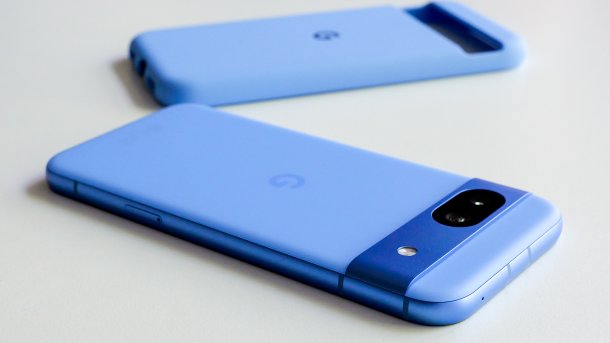
The PIxel 8a with cover in the shade of blue that Google calls "Bay" without b.
The Google Pixel 8a, which was unveiled a few days ago, is still doing its rounds in our test labs, but a few preliminary results may help you decide whether to pre-order it or not.

In the benchmarks, the Pixel 8a unsurprisingly achieves practically the same results as the Pixel 8 and 8 Pro, as the same processor is used in the three, namely Google's own Tensor G3 with nine cores. However, it throttles a little more than in the 8 Pro, for example the 3DMark dropped to around 60 percent. The 8a outperforms its predecessor, the Pixel 7a, by 10 to 30 percent. So high-end performance in the mid-range? Not quite, as the 8 and 8 Pro also lag the Snapdragon 8 Gen 3 models, as our high-end test in c't 9/2024 showed.
Two eSIMs can be stored, which is important for the future. In terms of Wi-Fi, the 6 GHz band, which is also essential for the future, is supported (Wi-Fi 6E), but Wi-Fi 7 is missing, unlike the 8 and 8 Pro. According to the first runtime measurements, the battery lasts a little shorter than the 8, 8 Pro and 7a - more details will follow. The 8a charges at a leisurely pace, Google itself speaks of 18 watts.
Videos by heise
Camera

The 8a does not have quite the same high-end camera as the Pixel 8, but Google has installed a slightly smaller sensor (1/1.73" instead of 1/1.31") with a smaller aperture (1.9 instead of 1.7), which has 64 instead of 50 megapixels. The photos of the 8a are calculated to 16 MPixel (4608 × 3456) by pixel binning, both the JPGs and the optional DNGs. The standard photo app does not offer a way to get the full 64 MP photos.
In fact, nothing has changed compared to the 7a. And in fact, all six models – i.e. Pixel 7, 7 Pro, 7a, 8, 8 Pro and 8a – are pretty close to each other in terms of image quality. Only in poor lighting conditions do the 7a and 8a capture less detail and more noise.
In all of them, a lot of the image quality is in the software, which Google regularly improves. In terms of artificial cropping (bokeh), night mode, video stabilizer or digital zoom, these six models don't have much in common. The 7 Pro and 8 Pro are clearly superior due to their zoom lenses.
Preliminary conclusion
If you own the Pixel 7a, you don't need a 8a because the advantages are too small. Only a few people recognize the 120 Hz refresh rate, whereas 90 Hz has a clear advantage over 60 Hz. We have not yet found any significant differences in the camera, and the battery life and benchmarks are too close together to justify a new purchase. At most, when the 128 GB flash runs out, an 8a with 256 GB may come into question. The air is getting thinner for the Pixel 5a and 6a, as the 8a offers more advantages.


The Pixel 8a's strongest competitor currently is the Pixel 8, as it is currently available from many retailers with 128 GB for less than 600 euros, only around 50 euros more than the Pixel 8a. Thanks to its thinner frame, the 8 is slightly smaller than the 8a despite its slightly larger display, has Wi-Fi 7 and takes slightly better photos. Google wants to provide seven years of updates for both, although the Pixel 8 only has six and a half years left. We still lack a few test results for a comparative look at other competitors. (jow)


