


Robot dog takes action against invasive, destructive fire ants
Invasive fire ants are a global problem because they can destroy local ecosystems. A robot dog is used to detect their nests.
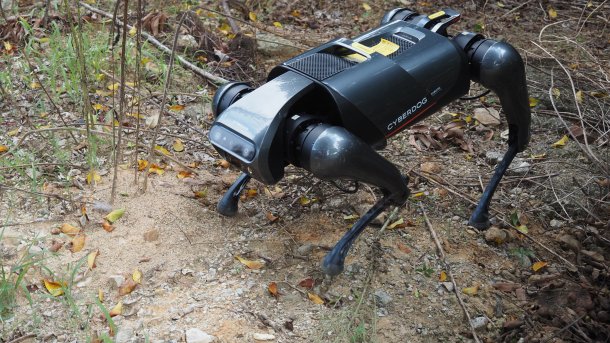
The modified CyberDog searches for fire ant nests.
(Image: Hualong Qiu / Guangdong Academy of Forestry)
An interdisciplinary research team from China and Brazil has equipped a robotic dog with artificial intelligence (AI) to help it locate fire ant nests. The Red Imported Fire Ant (RIFA – ) is not native to many countries, but has immigrated there and is one of the most destructive pests worldwide. The scientists hope that they will be able to automate the control of fire ants with the robot dog.
"Fire ant nests are difficult for untrained personnel to detect and confirm, and searching large areas can be time-consuming and exhausting under the hot sun. A robot could detect the nests automatically, without the need for specially trained people, and work at different times of the day regardless of temperature conditions," says Eduardo Fox, postdoctoral researcher at the State University of Goiás, outlining the problem.
Fire ants have now developed into a global problem. They were accidentally introduced to the USA in the 1930s. Since then, fire ants have spread further, for example to China, Japan and Europe. As an invasive organism, RIFA sometimes causes major agricultural damage there because it has no natural predators in these areas. The ecological damage can be immense: The fire ants displace and destroy local flora and fauna, including birds and small reptiles. On agricultural land, they are associated with mealybugs and can damage plants, making them more susceptible to pathogens.
Videos by heise
Attempts to control RIFA with conventional pesticides pose high environmental risks. Local ecosystems could be disrupted, which would prove counterproductive. One method is therefore to monitor RIFA populations and develop control strategies.
The scientists from China and Brazil are pursuing this approach with a robotic dog, as they describe in the study "The implementation of robotic dogs in automatic detection and surveillance of red imported fire ant nests", which has been published in Pest Management Science.
The study uses the CyberDog robot from Xiaomi. The researchers trained it to recognize RIFA nests using a machine learning system. They used around 1100 images of RIFA nests for the AI training. This enables the robot dog to autonomously detect ant nests. When it detects a suspected nest, the robot dog first presses on it with its front paw to lure the ants out. If they show particularly aggressive behavior, they are probably fire ants. The robot can thus distinguish RIFA from other species quite reliably. The robot dog was able to correctly recognize 90 percent of RIFA nests in field tests. That is three times more RIFA nests than human inspectors can detect, the researchers found in field tests.
However, there are still problems with using the technology: the battery life of the robot dog is too short. The batteries run out after around 30 minutes of use. One possibility would be to use more efficient robot dogs. However, these are significantly more expensive than the CyberDog from Xiaomi. However, the researchers believe that it may be worth using them to carry out ecological pest control.


(olb)


