


GameNGen: Google researchers simulate "Doom" without an engine
Google researchers presented their GameNGen project, which can recreate “Doom” in real time without an engine. The shooter is almost identical to the original.
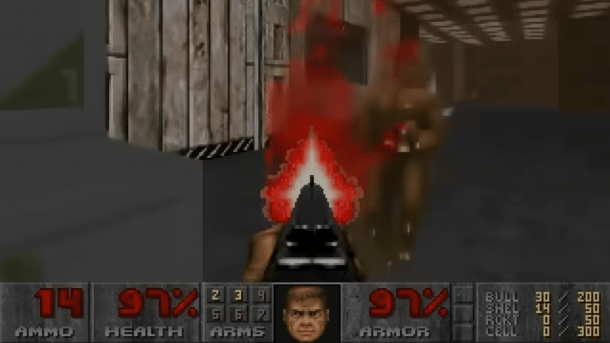
Screenshot from AI-generated "Doom"
(Image: Google)
Google has presented AI technology called GameNGen, which builds the shooter "Doom" on a TPU completely without an engine in real time. The resulting AI "Doom" is interactive and playable. For humans, the difference to the original game is apparently difficult to tell from the video material.
The game runs at 20 FPS, but according to Google, GameNGen can also generate 50 frames per second with a loss of quality.
Empfohlener redaktioneller Inhalt
Mit Ihrer Zustimmung wird hier ein externes YouTube-Video (Google Ireland Limited) geladen.
Ich bin damit einverstanden, dass mir externe Inhalte angezeigt werden. Damit können personenbezogene Daten an Drittplattformen (Google Ireland Limited) übermittelt werden. Mehr dazu in unserer Datenschutzerklärung.
GameNGen is essentially a pumped-up version of the Stable Diffusion image generator in version 1.4, which generates frames based on previous images and user input. A neural network manages the game status – and remembers how much ammunition is used, how many health points the character has, which doors are opened and whether enemies have been hit.
Images, videos and games from the AI
Google's AI technology builds "Doom" in real time, taking into account the player's input. First, an AI agent was trained to play the original "Doom" using reinforcement learning. These attempts were recorded. Finally, the diffusion model was trained to generate new frames from previous images and user input. This is reminiscent of Nvidia's DLSS3 frame generation technology, which is already used in some modern games and inserts an AI frame between two traditionally calculated frames.

(Image: Google)
The researchers from Google and Tel Aviv University present their GameNGen model in a paper and have published videos of the AI-generated game. Their experiment shows that neural networks can basically simulate video games in high quality in real time. AI can therefore not only generate images and videos, but also games, they conclude in their paper.
GameNGen only works with "Doom"
However, the technology is not perfect. GameNGen can only remember three seconds of the past. There is therefore no guarantee that game elements such as ammunition, health points and the status of enemies will remain stable and meaningful over longer sessions. In addition, the AI model was trained exclusively on "Doom" and, according to the researchers, cannot be easily applied to other games. More modern graphics than in "Doom", which was released in 1993, could also massively increase the computing costs.

Google writes that people can hardly tell the difference between the AI-generated "Doom" and the original. However, it is worth taking a closer look: In the published video material, random fluctuations in ammunition levels are clearly visible. In addition, enemies seem to blur when moving.
Videos by heise
One fundamental limitation remains: GameNGen requires material from an existing video game in order to be able to recreate it. It is therefore not possible to develop completely new games with the current approach. Nevertheless, developer studios could use such technology to speed up the development of their game and save costs, says Google. AI technology could also be used to change the behavior of existing games and create mods. "For example, we might be able to convert a set of frames into a new playable level or create a new character using only sample images, without having to write code."


(dahe)

