


Researchers: Bundeswehr eavesdropping unit operating on thin constitutional ice
The little-known Military Intelligence (MilNW) of the Bundeswehr acts like an intelligence service – only without a legal basis, restrictions and control.
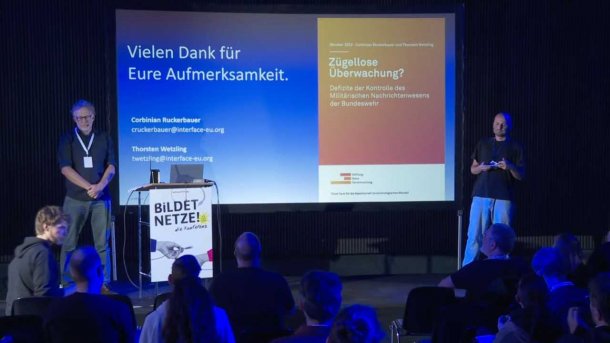
Researchers Corbinian Ruckerbauer and Thorsten Wetzling from the Interface think tank (formerly Stiftung neue Verantwortung) during their presentation on military intelligence at the Netzpolitik.org conference "Bildet Netze" (Build Networks).
Largely unnoticed by the public, the Military Intelligence Service (MilNW) and its almost 7,000 employees have established themselves as the largest German intelligence service in the Federal Republic of Germany. In contrast to the three better-known institutions, the Federal Intelligence Service (BND), the Federal Office for the Protection of the Constitution (BfV) and the Military Counterintelligence Service (MAD), it is allowed to conduct almost unbridled surveillance and is virtually unchecked.
Corbinian Ruckerbauer and Thorsten Wetzling from the think tank Interface (formerly Stiftung neue Verantwortung) made this clear on Friday at the Netzpolitik.org conference "Bildet Netze" in Berlin. Both say that this construct is highly questionable under constitutional law. The traffic light coalition knows this, but is doing nothing about it.
Targeting people abroad
The MilNW does not focus its attention on the troops themselves, but primarily on people in other countries, as the two researchers have also elaborated in a specialist article. To this end, the service listens to conversations on radios and cell phones, recruits informants abroad and systematically and automatically evaluates information from the Internet.
All of this serves the MilNW's core task of meeting the military information needs of political and military decision-makers, including the German government.
The BND also supplies the MilNW with data
A core area of the MilNW is telecommunications reconnaissance, also known as Signals Intelligence (SIGINT). This is carried out using stationary antennas and mobile sensors on ground, air and water vehicles, explained Ruckerbauer.
In addition, the BND automatically transmits huge amounts of data from its own SIGINT to the Bundeswehr. It is extremely difficult to ensure "that only military personnel are affected".
No law for the interception force
Both the military intelligence service and the BND intercepted communications on a large scale. It is technically impossible to exclude considerable amounts of "by-catch", for example about uninvolved and unsuspicious civilians. Added to this is the use of publicly available information and, since 2023, data from the armed forces' Sarah satellite system.
Wetzling sees several problems with this form of surveillance. For example, there is massive interference in the basic rights of civilians. These include the secrecy of telecommunications, freedom of the press and informational self-determination. This requires a normatively clear and specific legitimation as well as protective provisions to ensure that the whole thing is not disproportionate.

The Federal Constitutional Court made this clear with the BND ruling in 2020 at the latest. The judges in Karlsruhe were aware that data would be collected and that a "very granular personal profile" could be created in conjunction with other methods. They spoke of "additive encroachments on fundamental rights".
However, the duo complained that to date there has been no specific law regulating the surveillance activities of the Bundeswehr's interception unit. If at all, requirements are only laid down in internal service regulations, which is completely inadequate. "There's explosive material in there," emphasized Wetzling.
Researchers warn: BND could circumvent its own rules
For the BND, on the other hand, there have been many requirements for surveillance measures for several years. For example, it must first define a legitimate purpose, provide evidence of a specific danger and comply with restrictions. The order procedure must be carried out in writing in order to enable a review of admissibility.
Ruckerbauer sees a particular danger to fundamental rights in the MilNW's approach if its activities overlap with those of the BND and MAD in particular, resulting in "close cooperation with simultaneous major discrepancies in the density of regulation". This could lead to regulations being circumvented.
It is obvious that the foreign intelligence service in particular would outsource tasks to the MilNW, as the military intelligence service could operate much more freely.
Videos by heise
While particularly intrusive measures of the BND are subject to independent legal review, the approval of the Bundeswehr takes place within the authorities, the researchers point out. However, Karlsruhe has highlighted the importance of independent prior review for such interventions in several judgments. This is because where those affected can otherwise defend themselves in court afterward, this is hardly possible in the case of covert surveillance.
There is another gaping hole in parliamentary oversight. This is limited to the broad mandate of the defense committee and its limited resources. Many members of parliament also know little about the MilNW. None of this meets the minimum constitutional requirements.
Kelber criticized numerous data protection violations
In his current 32nd activity report, Federal Data Protection Commissioner Ulrich Kelber, who recently left office, reported for the first time on an inspection of the MilNW at the Heinrich Hertz Barracks in Daun/Eifel. In it, he complains of numerous breaches of data protection law.
For example, the relevance of the information collected is often unclear, the databases are poorly maintained and there are hardly any deletions. Furthermore, the protection of data on minors is not guaranteed.
Traffic light coalition not acting "with their eyes open"
Kelber also criticized the lack of a legal basis. However, the inspector could not enforce regulations or sanctions and delete illegal files – but lacked the authority to do so.
"Ruckerbauer and Wetzling criticized the fact that the traffic light government did nothing in the MilNW case despite its promise of comprehensive intelligence reform. In a 2011 Kunduz report, for example, the SPD parliamentary group highlighted considerable coordination and control problems relating to the military intelligence service, which the government and legislators must solve.
Defense Minister sees "no particular need for regulation"
Before joining the government, the Greens criticized the fact that the MilNW was carrying out mass interventions in basic rights without a legal basis. This situation is incompatible with the Basic Law and damages the public's trust in the Bundeswehr.
Defense Minister Boris Pistorius, on the other hand, recently stated that the military intelligence service and the MilNW have a special status: "That's why I don't see any particular need for regulation."


(nen)

