


FireSat: Google supports satellite-based forest fire warning system
Forest fires are a global problem. Google wants to set up an early warning system accordingly. Satellites and an AI are to detect the fires.
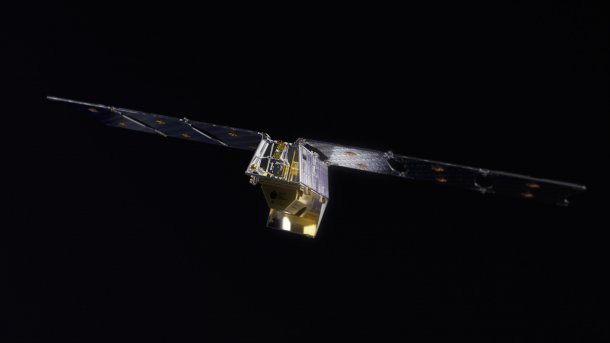
This is what a FireSat satellite for detecting whale fires should look like (rendering).
(Image: Google)
Google is providing financial support for the development of the satellite-based early warning system for forest fires FireSat. The system is being developed by the non-profit organization Earth Fire Alliance and the start-up Muon Space together with scientists from Google Research. The system should also be able to detect smaller, developing fires from a close earth orbit so that the fires can be extinguished more quickly.
The FireSat satellite network consists of more than 50 satellites, which are to be used exclusively to locate forest fires. The plan is for FireSat to check every 20 minutes whether forest fires have occurred anywhere in the world. Even small fires of around 5 m × 5 m are to be detected in this way.
Existing satellite-based detection with shortcomings
Existing satellites are also capable of detecting fires. However, these fires must first reach a size of two to three hectares before they can be detected. The satellites also only pass by the site a few times a day and can only detect the fires after a delay. According to Google, it was therefore necessary to develop a new satellite network that does not have these disadvantages and can also detect forest fires more quickly.
Videos by heise
In order for this to work with FireSat, the development team has developed special sensors and artificial intelligence that can evaluate the image data and detect a fire. The images are also to be compared to monitor the spread of the fire, for example, and to provide research material for forest fire scientists worldwide.
The first satellite in the FireSat project is to be launched into low-Earth orbit at the beginning of 2025. Three more satellites are then to follow in 2026. The development of FireSat has already been underway for five years.



(olb)

