


Space Perspective: Successful test of the balloon-powered Neptune spacecraft
Space Perspective has launched its Neptune Excelsior space capsule to an altitude of 30 km and tested various systems.
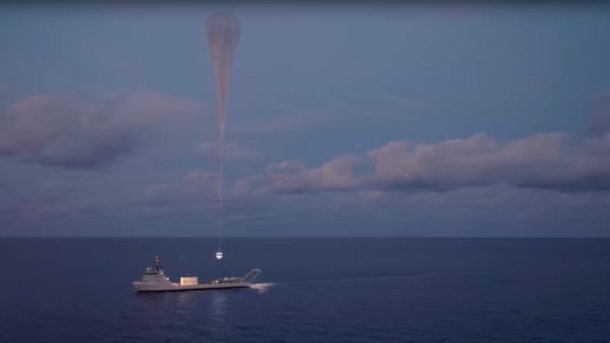
The launch of the Neptune Excelsior from the MS Voyager.
(Image: Space Perspective (Screenshot))
Space Perspective, a company based in the US state of Florida, has come one step closer to carrying out space explorations by tourists. As the company announced, a test flight (development flight 2) of its Neptune Excelsior spacecraft has been successfully completed. The space capsule is lifted by an approximately 200-meter hydrogen-filled balloon, the SpaceBalloon. The balloon was specially developed for the stresses and requirements at high altitudes. The Neptune Excelsior ascended to an altitude of 100,000 feet (about 30 km) and was brought back to the ground in a controlled manner.
The unmanned capsule was launched on September 15 from the ship MS Voyager off the coast of St. Petersburg in Florida. A special device on board uses cables to bring the Neptune Excelsior into position before the launch takes place. The capsule with a diameter of 5 m and an interior volume of 60 m³ is designed for eight people plus the captain.
Videos by heise
System tests
During the two-hour ascent to 100,000 feet (approx. 30 km), over 99 percent of the Earth's atmosphere, the company tested the launch system as well as other systems, including the pressurization system. The engineers also checked the thermal management inside the capsule. Thermal management is particularly important in order to be able to compensate for extreme temperature fluctuations, such as low temperatures in the cold upper atmosphere and high temperatures caused by direct sunlight.
The capsule remained at altitude for two hours until the descent was initiated. To do this, the hydrogen was gradually released. The descent took place after a further two hours. A speedboat and a crane were used to recover the Neptune capsule.
During the six-hour mission, flight control used its own mission software and communication systems, which were also tested. Space Perspective intends to use the data collected to create an even more detailed digital twin of the spacecraft in order to advance the development of the capsule for manned missions and later for space tourism. One
There are apparently enough interested parties: Space Perspective claims to have already sold 1800 tickets at 125,000 US dollars each. The first commercial flights are scheduled to take place as early as 2025.



(olb)

