


Meta and the Orion glasses: Greetings from another star
Meta has made a strong showing with Project Orion. The message is unmistakable: Meta wants to know. But do people want it too, asks Malte Kirchner.
(Image: heise online)
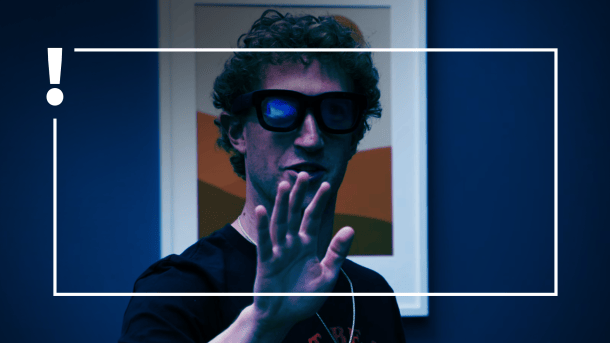
Kudos to Meta: The Facebook group held its product keynote on Wednesday in a way that some Apple fans would wish for. Not only did CEO Mark Zuckerberg himself present his news on a stage – and not in a video –. In addition to the expected – AI functions, new Ray-ban glasses and a quest –, he also had a real surprise in store: Project Orion, the prototype of real AR glasses –, which is at least the closest thing to what many people imagine augmented reality will look like in the future, given today's technical possibilities.

The messages sent by Meta were unmistakable: this, dear competitors – also in Cupertino – is what the future must look like! Meta has not only set the bar high for others, but above all for itself: People will look back on this keynote one day and ask what has become of it. After changing its name to Meta a few years ago to show that the Metaverse is more than just a product, now comes the clearly formulated second mission to itself: AR must continue in this direction. And that's just the minimum. In any case, the presentation of Orion was more than just a slogan. It was a statement. It made it clearer than ever before that Meta really wants to grow beyond social networks.
Distant worlds
At the same time, however, the name of the project is enough of a hint not to expect too much too quickly: the constellation Orion is far away –, as are presumably the glasses as a consumer device. And evil tongues might suggest that the star Betelgeuse can be found in this constellation – a hot candidate for a supernova. One can only hope that Meta does not destroy itself with this ambitious project.
Nevertheless, – and this is surprising – even the day after, the first reactions to this technical sensation are rather restrained. Is it because of Meta, a company that is primarily known for its data collection mania in social networks? Perhaps. But experience shows that publishers who don't like it are no showstoppers when it comes to admiring a technical innovation. After all, Elon Musk is still attracting attention with SpaceX and Tesla, although he is certainly not everybody's darling. And if somewhere, somehow a new generative AI model tumbles out that presents photos or videos in unexpected beauty, the social media are full of euphoria – In the case of Orion, many posts sounded rather friendly and approving.

Success by any means necessary
Two of the financially strongest tech companies in Silicon Valley, Meta and Apple, are currently working on the topic of mixed reality. Both have freed up enormous resources to bring the Metaverse or Meta hardware to life for one and the Vision Pro for the other. And although the technology initially fascinates almost every wearer – as well as the author –, the first questions soon arise after setting it down. What do I need it for? Do I really use it often? And do I really want to wave my hands in the air in front of others or even in public?
Videos by heise
Perhaps it is also the case that with every step forward that AR technology takes, we as humanity discover more of our own need to remain in the shared reality. Because the vision of the future that Big Tech is painting is one where everyone experiences and sees their own reality. A reality in which you can call other people as video call or gaming partners from a distance. But in the user's immediate vicinity, regardless of the design, it is a technology that, despite all efforts to integrate external reality, is exclusionary. To recognize these disadvantages, today's technology in the form of Meta Quest 3 and Apple Vision Pro is enough.
Not of this world?
Is this the point that makes many people – perhaps also subconsciously – not applaud too euphorically? Hard to say. It could just as well be the high prices, the growing dependence on tech companies and the fact that the technology is still in its infancy that are putting people off. Although these are factors that have at least not prevented AI from generating hype. A hype that the masterminds of mixed reality still long for today.
But perhaps they are simply living in a different reality than most people with their idea that MR is the next big thing.


(mki)

