


Fourier GR-2 humanoid robot: modular design, longer battery life
Fourier has revised its humanoid robot GR-1. The GR-2 should be able to move more human-like with adapted actuators.
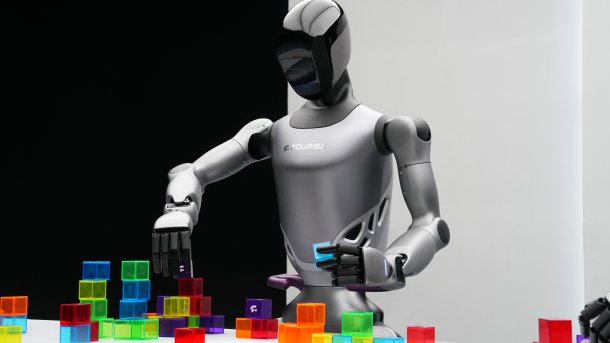
The GR-2's tactile capabilities help it to handle objects safely.
(Image: Fourier)
Chinese robotics company Fourier has launched the GR-2, the second version of its GR series humanoid robot. The company announced this on Monday. The successor to the GR-1 now has a modular design to keep production and maintenance costs low. The engineers have also worked on the robot's movements. Thanks to specially tailored actuators for the individual joints, they should be more human-like than before. The company has also increased the size of the battery so that the robot can last longer.
At 1.75 m, the GR-2's height has remained the same as its predecessor. It now weighs 65 kg. The body has 53 degrees of freedom. For the first time, the GR-2 has been given 5-finger hands with twelve degrees of freedom, which are modeled on the human hand. They include a 6-fold tactile sensor array. It enables the force exerted on the hand with its fingers to be detected. Fourier states that the GR-2 can thus "feel" the shapes of objects and their materials. This enables the humanoid robot to handle a wide variety of objects better.
Stronger and more precise actuators
The actuators used in the FSA 2.0 series are also new. They have been specially adapted to the individual joints to better meet the torque requirements of the joints. At their peak, the actuators deliver a torque of up to 380 Nm. At the same time, agility, speed and precise control have also been increased. According to Fourier, the control accuracy has been approximately doubled. The movements are now more human-like with the new actuators. One arm can lift up to 3 kg of payload. The robot can move at a speed of 5 km/h.
Videos by heise
The engineers have also improved the cable design for the power supply and the transmission of the GR-2's signal paths. The robot now has a modular design. This makes it easier to adapt to different application scenarios. The connection configuration has been changed from parallel to serial. This simplifies troubleshooting and reduces maintenance and manufacturing costs.
The GR-2 is powered by a larger battery than before. It is now replaceable and is said to extend the runtime by one hour to two hours.
The development platform of the GR-2 has been optimized by the introduction of a new software development kit. It is compatible with common programming languages such as the Robot Operating System (ROS). Developers can easily access pre-programmed modules for machine vision, path planning and force feedback control via APIs. Frameworks such as Nvidia Isaac Lab and Mujoco are supported. Developers can thus accelerate robotics development.



(olb)

