


Germany's first photonic quantum computer computes in Paderborn
Light goes into the machine and is manipulated there. The result of the calculation is shown by where the light particles come out again.
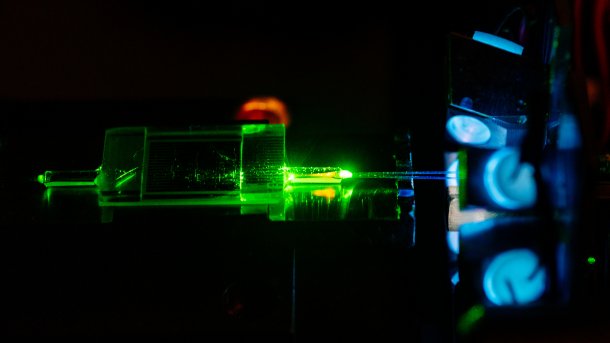
Pigtailing: Connection of a fiber optic cable with an integrated optical quantum component
(Image: Universität Paderborn/Besim Mazhiqi)
Europe's largest sampling-based quantum computer is now computing at the University of Paderborn. It is called PaQS (Paderborn Quantum Sampler). A second device is soon to go into operation at the Fraunhofer Research Institute for Optics and Precision Engineering (IOF) in Jena. Quantum mechanical phenomena such as squeezing and the superposition or entanglement of photons are responsible for the incredibly high computing power of quantum computers.
Various quantum computer designs are being researched around the world. Photonic quantum computers use light to perform quantum calculations, while other approaches to quantum computing are based on superconducting qubits or trapped ions, for example. The advantages of photonic quantum computers include a clear path to scalability and high clock rates. The systems, which work with small particles of light (photons), have the advantage that they can be operated at room temperature and implemented in miniaturized, programmable circuits.
Videos by heise
"But they have to contend with optical losses," explains Professor Christine Silberhorn, physicist at the Institute for Photonic Quantum Systems at Paderborn University, "We are tackling this problem by drawing on Germany's world-leading expertise in integrated photonics. We have succeeded in realizing a so-called 'Gaussian boson sampler' that consists of scalable components. Many components first had to be newly developed for this. This is a complex process".
Squeezed light
The starting point is always the generation of a specific quantum resource. Silberhorn explains: "In Gaussian boson sampling, this resource is known as 'squeezing' or 'squeezed light', whose quantum mechanical properties have been manipulated and thus made usable. The Integrated Quantum Optics group at Paderborn University has a long tradition of using optical waveguides to develop highly optimized squeezed states. We have drawn on this expertise to produce a light source that powers the PaQS machine."

(Image: Universität Paderborn/Martin Ratz)
PaQS is said to be the largest Gaussian boson sampling machine in Europe. In simple terms, – – measures which outputs of a photonic network the photons come from. The device should be fully programmable.
"In concrete terms, this means that we use a fully programmable and integrated interferometer with which we can implement any desired configuration. In this approach, light particles are distributed and directed in a network of optical fibers - you can think of it as a network of switches in a marshalling yard. At the output of the network, you measure where the photons emerge from the network. This could be relevant for solving protein folding problems or calculating molecular states in the context of drug research, for example", Silberhorn explains. The complete programmability means that applications that are still unknown today can also be implemented. The system is currently being expanded to enable more complex calculations and to serve as a basis for investigations into future devices.

The photonic quantum computer is part of the PhoQuant funding program of the Federal Ministry of Education. The funding volume amounts to around 50 million euros. The project is being coordinated by the German quantum technology company Q.ANT with a total of 13 partners. The aim is to "bring Germany to the international forefront of photonic quantum computing", as the University of Paderborn puts it.


(ds)

