


New auroras in the coming nights
After several severe eruptions on the sun, a plasma cloud is on its way to Earth. The US weather agency warns of a severe magnetic storm.
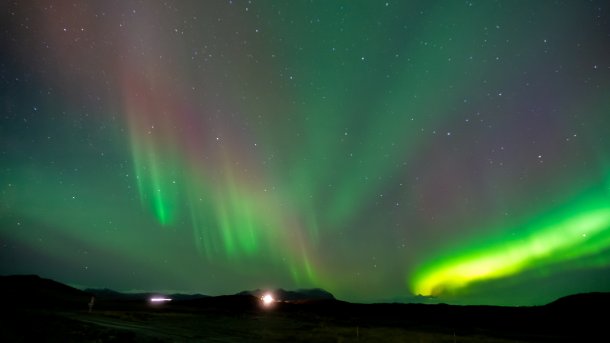
Aurora Borealis over Iceland
(Image: mapimarf/Shutterstock.com)
The sun is currently more active than it has been for over 20 years. In the past few days, a series of several eruptions have occurred, which landed at level three on the five-point scale of the US weather agency NOAA, which is also responsible for observing space weather. The last of these eruptions was associated with a coronal mass ejection, i.e. ejected plasma into space. According to experts, the plasma cloud will hit the Earth right on target. The NOAA has issued a warning of a severe class four out of five magnetic storm for today (Thursday) and tomorrow (Friday). According to the calculations, the shock front will reach the earth today at around 4 p.m. Central European Time, but such forecasts are subject to considerable uncertainty.

(Image: NOAA/SWPC)
Magnetic storms of the predicted magnitude usually cause bright northern lights. The northern lights zone can move far to the south. For Europe, this means that northern lights will not only be visible in the north of Finland, Sweden and Norway, but possibly as far as Germany. It is therefore worth looking for auroras after 8 p.m., when the night sky is completely dark, if the cloud cover allows it. Northern Germans have a clear advantage here: the more northerly the location, the higher the chance that the aurora will be visible in the night sky. A location with as little light pollution as possible is also important. If the Northern Lights are not visible to the naked eye, it may be possible to capture them with a camera. The best chances for this are likely to be on Thursday night, but the magnetic storm could also continue on Friday.
Technical consequences
For power grids or satellite systems, a class four storm is a burden, but not a danger. However, the GPS location, for example, may be displayed less accurately because the highly excited ionosphere diffracts and distorts the satellite signals. Radio amateurs prefer to use the reflections of signals in the 2-meter band at 144 MHz to establish long-range connections over 1000 km during strong aurora events.
Videos by heise
The current active phase is accompanied by a strong radiation storm, i.e. high-energy protons reaching the earth. This storm has just reached level three on the five-point warning scale. The charged particles are deflected by the Earth's magnetic field and hit the polar regions. There they cause an increase in cosmic radiation and an extremely high attenuation of short-wave signals. In the event of particularly strong events, flights at high latitudes have to be diverted or switch to lower altitudes in order to reduce the radiation exposure of crew and passengers.


(uma)


