


Robo-brain: Sikorsky installs autonomous flight system in Black Hawks
The US Army wants to modernize its Black Hawk helicopters and teach them to fly autonomously. This could be an advantage in dangerous missions.
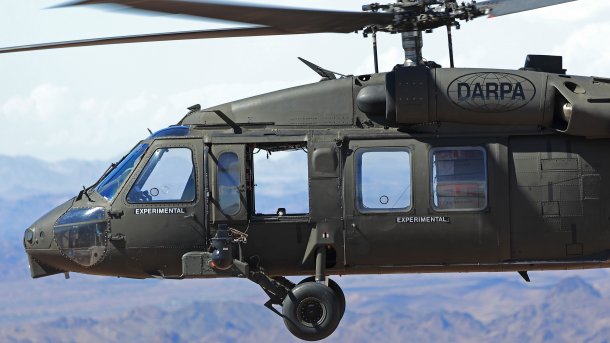
A Black Hawk helicopter flies without a pilot on board.
(Image: Lockheed Martin)
The aviation company Sikorsky, a subsidiary of the US defense contractor Lockheed Martin, has received USD 6 million from the military research arm of the US Defense Advanced Research Projects Agency (DARPA) to equip an experimental fly-by-wire UH-60M Black Hawk helicopter of the US Army with the autonomous flight system ALIAS/MATRIX. The normal version of the helicopter has been a popular model in the US Army since the 1970s, where it is regarded as a workhorse. The aim is to equip Black Hawks in the coming years so that they can fly completely unmanned or at least with just one pilot.
The Black Hawk helicopter retrofitted with an autonomy system will be given the additional designation MX. It will initially be used for autonomous flight tests. The U.S. Army Combat Capabilities Development Command (DEVCOM) is monitoring the tests and assessing its suitability for military use.
Videos by heise
The MX version is based on an Aircrew Labor In-cockpit Automation System (ALIAS) developed in 2020 as part of the DARPA program. The system makes it possible to fly a UH-60M via fly-by-wire, i.e. electronic signal transmission of control commands via cable. This also enables the connection of autonomous control systems, as the control is already basically electronic. The autonomous MATRIX system, which has already been tested over hundreds of flight hours, now needs to be integrated for military use. According to Sikorsky, this should happen in 2025.
Autonomous flying
DEVCOM will then test the system in practice and develop it further. This will involve evaluating the system's various sensors, for example to detect and avoid threats and obstacles in the terrain. Standards and system specifications will also be developed.
This was preceded by a demonstration of the technology to DARPA, the US military and representatives of the US Department of Defense in July 2024. An operator was able to control and fly the helicopter from the cabin and from the ground by entering high-level mission objectives via a tablet.
In an ideal scenario, the completed Black Hawk MX could fly autonomously in dangerous missions without a human crew or be controlled from the ground. The MATRIX system should also be able to relieve the pilot. Until now, at least two pilots had to be on board. The autonomous system could save one of them.



(olb)

