


Digital strategy: Wissing wants to systematically dismantle analog processes
The Ministry of Digital Affairs believes that the implementation of the government's digital plans is well underway. It is time for a "digital only" strategy.
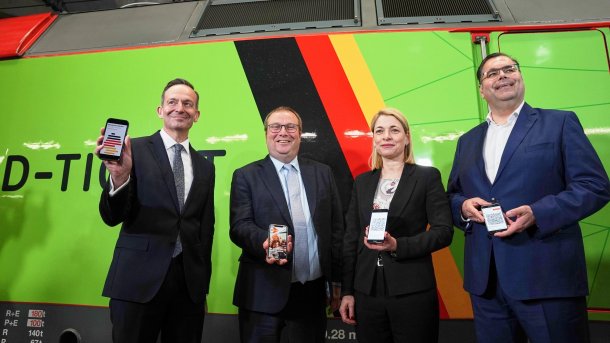
Federal Transport Minister Volker Wissing praises the digital Deutschlandticket as a milestone in digitalization.
(Image: VDV)
"Digital first, concerns second." This was the FDP's slogan going into the 2017 federal election campaign, and Volker Wissing, Federal Minister for Digital Affairs and a member of the Liberal Party, is now going one better: "It's time to turn the digital strategy into a 'digital only' strategy," he emphasized on Friday. "We need to systematically dismantle parallel analog structures and focus on completely digital processes."
This is not only more efficient and saves costs, but also improves data availability, Wissing emphasized: "Only if we become a fully digital country can we develop Germany into a leading AI location and strengthen our position in international competition."
Analog was yesterday
The reason for the plea: The Federal Ministry for Digital and Transport Affairs (BMDV) has published the 2nd progress report on the federal government's digital strategy. The minister summarized the results as follows: "Millions of citizens are using new digital services such as the Deutschlandticket, Bund-ID or e-prescription." The state must therefore consistently continue on its chosen course.
The minister immediately received backing from the IT association Bitkom. Its Managing Director Bernhard Rohleder explained: "We cannot continue with inefficient analog processes until the day after tomorrow. Analog processes must be phased out and discontinued step by step." It is important that "digital only" also and primarily applies to Germany's administrations.
Civil rights organizations such as the Humanist Union and Digitalcourage, on the other hand, have long warned against a digital compulsion. They demand that basic administrative services and companies such as Deutsche Bahn must remain available in analog form. The Greens also do not believe in forced digitalization, although the public sector would then have to continue to operate on two tracks. Bitkom wants to grant "digitally distant people" "support in accessing digital administrative services", at least at public offices.
Federal government emphasizes successes
According to the outdated strategy, high-performance networks, more available data, open standards, open source and secure digital identities should help Germany to finally get off the ground digitally. The Digital Ministry now states that 87 of the 100 planned measures have been implemented or are in progress.
In the area of networks, approval procedures have been simplified and digitized and modern laying methods have been made easier, the BMDV emphasizes. Over 92% of Germany is covered by 5G through at least one network operator. Around one in three households have the opportunity to connect to a fiber optic network – twice as many as in 2021. The EU Commission has even praised the local expansion as "spectacular". The German Broadband Association (Breko), on the other hand, has just warned that the government's medium-term fiber optic target is at risk.
In the mobility sector, the authors note that over 13 million people use the digital Deutschlandticket. Since June, the BahnCard has been offered exclusively in digital form. This saves 30 tons of plastic per year. Digital vehicle registration has cracked the million mark. Drivers have saved time and money over 1.5 million times with i-Kfz.
Videos by heise
Germany as an AI location
The ministry also sees Germany as an AI location on the upswing. The number of AI start-ups is growing significantly. New centers and real laboratories are supporting German SMEs in the introduction of artificial intelligence. The first European exascale supercomputer, Jupiter, is currently under construction at the Jülich Research Center.
The authors consider e-prescription and the "ePA for all" to be "milestones" in the healthcare sector. Furthermore, the OZG 2.0 has given fresh impetus to e-government. However, the Federal Court of Auditors revealed the weaknesses of administrative digitization.


(vbr)


