


NASA shows prototype of telescope for LISA gravitational wave observatory
The LISA space observatory will soon be searching for gravitational waves with unrivaled precision. The prototype of a central instrument has now been unveiled.

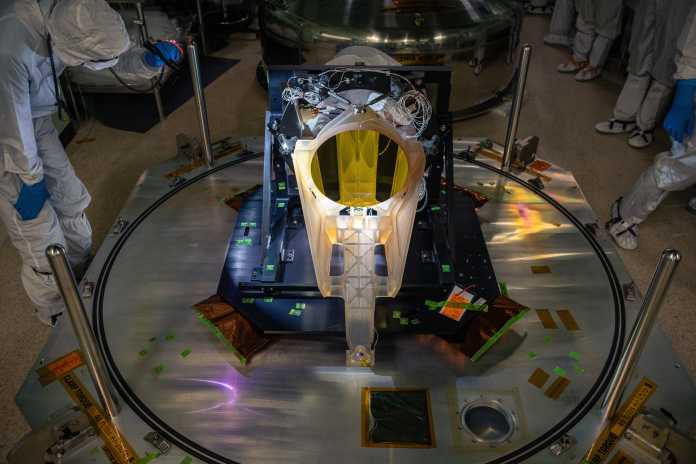
The prototype during a test
(Image: NASA/Dennis Henry)
NASA has unveiled the first prototype of one of the telescopes that will play a key role in the search for gravitational waves at the planned LISA space observatory. The full-size telescope had already arrived at NASA's Goddard Space Flight Center in May, but has only now been demonstrated. Photos show the device made of a special translucent ceramic from the Mainz-based company Schott and the gold-coated primary mirror. The prototype will help to prepare the development and construction of the actual devices for the space observatory, writes NASA. A total of six of the instruments are needed, two on each of the three satellites. All of them will use a laser to determine the distance to one of the other satellites with high precision.
LISA: Prototyp eines Teleskops (5 Bilder)
NASA/Dennis Henry
)LISA (Laser Interferometer Space Antenna) is one of ESA's most ambitious missions. The technology has already been tested with the LISA Pathfinder probe, which clearly exceeded expectations. The actual mission will consist of three satellites orbiting 2.5 million kilometers apart, each carrying a mass. The exact positions of these masses will then be measured using lasers and NASA's high-precision telescopes. The aim is to detect gravitational waves. Because there are far fewer sources of interference in space than on Earth, those responsible expect more precise data than can be collected on Earth with detectors such as LIGO. The project is due to start in the middle of the next decade.
Videos by heise
Gravitational waves were already postulated by Albert Einstein's theory of general relativity, but it is only recently that they have actually been detectable. They are minuscule deformations of space-time that originate in particularly extreme environments in the universe. The deformations propagate at the speed of light and have so far mainly been found using the LIGO, Virgo and Kagra detectors. These are high-frequency signals that can be traced back to collisions between black holes, for example. Last year, the so-called cosmic background of gravitational waves was also successfully detected.
High expectations
However, while it will still be years before LISA takes its first measurements, scientists have been working for some time on what exactly can be expected from the observatory. It has already been determined that LISA will be sensitive enough to even detect exoplanets under certain circumstances – in the Milky Way and beyond. However, one of the main objectives of the mission is to search for gravitational waves, which are produced when supermassive black holes collide. These should reveal how these objects evolved and how they came to have their immense masses in the first place. Because it adds a new dimension to astronomy, it will be like when silent movies suddenly had sound, promises LISA project researcher Oliver Jennrich.



(mho)

