


Microsoft CEO: "Copilot is the user interface for AI"
Microsoft is beating the drum for artificial intelligence on its "AI Tour". In Berlin, CEO Satya Nadella presents his vision of a "world of agents".
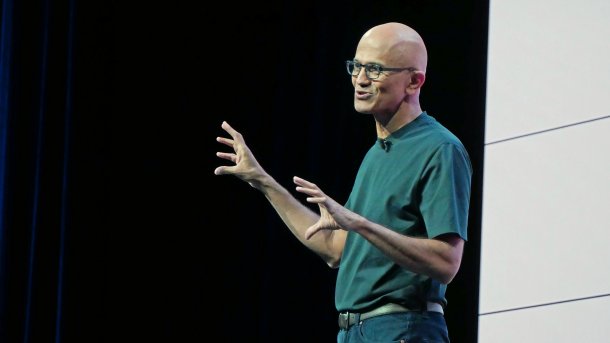
CEO Satya Nadella stops off in Berlin as part of Microsoft's "AI Tour".
(Image: heise online / vbr)
Microsoft is going "all in" with artificial intelligence (AI) and on tour: the software giant is currently touring 39 cities around the world with new products and use cases for AI to demonstrate the benefits of its in-house AI solutions to customers from companies and the public sector. On Thursday in Berlin, CEO Satya Nadella spoke about the immense speed at which AI technology is developing – and how the economy can benefit from it.
With AI, considerable efficiency gains are possible for the economy, emphasized Nadella in front of around 3,000 participants in Berlin. The performance of AI systems will double approximately every six months. "The question now is how do we transfer this to the real world", said the Microsoft CEO. "How can AI really make a difference for small and medium-sized companies?"
Copilot in industrial production
At the "AI Tour", Microsoft will show how this works using a number of practical examples. At machine manufacturer Thyssen Krupp Automation Engineering, for example, which produces production lines for the automotive industry, Siemens Industrial Copilot, jointly developed by Siemens and Microsoft, helps with the setup and maintenance of complex machines.
"There is hardware from us in every third industrial machine," said Erik Scepanski, who develops new solutions with generative AI at Siemens. The in-house co-pilot for industrial applications can, for example, support the programming of the system by translating instructions into correct automation code. Or it can help to analyze and rectify errors during operation.
Copilot is the ubiquitous access to AI tools in Microsoft's products and services. "Think of Copilot as a user interface for AI," explained Nadella, recalling the old computer science dream of "having computers that understand us instead of us having to understand computers". This is now a reality.
With AI, business life is becoming a "world of agents", as Nadella put it. Recently, Microsoft presented so-called autonomous agents that can be created with Copilot Studio – completely "low code", emphasized Nadella. These agents react to certain triggers and then complete their task.
For example, an agent can find the appropriate contact person in the company when an email is received at a collective address and forward the request. According to Microsoft manager Jared Spataro, the management consultancy McKinsey has been able to reduce the time that elapses between contacting new interested parties and the processing by the responsible employee by 90 percent.
Videos by heise
Alliance for AI expertise in Germany
Microsoft considers Germany to be an important AI market. This is another reason why it is important to qualify people in companies for the use of artificial intelligence. "The future of work depends on everyone's ability to train employees on a large scale," said Microsoft's new Head of Germany Agnes Heftberger in Berlin.
Together with companies, associations and representatives of the public sector, Microsoft has therefore launched the "Alliance for AI Competence in Germany". Among others, the employers' association, Bitkom, Deutsche Telekom and Siemens Energy are also involved. The aim is to enable employees in small and large companies to receive further training in AI topics.
"The associations and companies are already doing an excellent job of providing further training in the field of AI," said Heftberger. "Our aim is to learn from each other and adopt proven recipes for success. Nobody has to reinvent the wheel."


(vbr)


