


First image of the Milky Way's central black hole "flawed"
Two years ago, the image of the Milky Way's central black hole wowed the world. Now a research team believes that it is "not accurate".
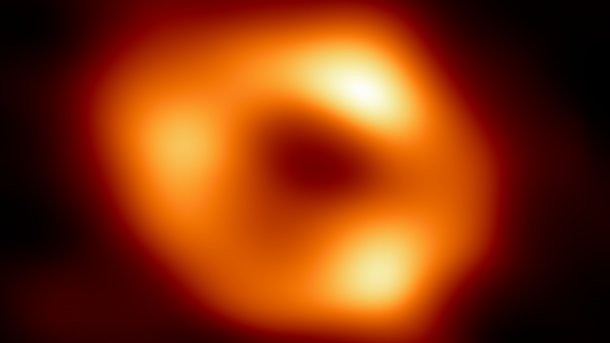
The first – and allegedly false – image of Sagittarius A*
(Image: EHT Collaboration, CC BY 4.0)
The first direct image of the supermassive black hole at the center of the Milky Way could be "not a faithful image of its appearance". At least this is the conclusion reached by a research group led by radio astronomer Makoto Miyoshi from the National Astronomical Observatory of Japan, who have analyzed the data from the Event Horizon Telescope (EHT) differently. If widely used, traditional methods were used to analyze the measurement data instead of the EHT's own, the black hole would appear more elongated and not so round, the team now claims.

(Image: Miyoshi et al./CC BY 4.0)
Error in the first image creation
As the research group recalls, the image of the black hole Sagittarius A* published in 2022 shows a central region and a bright ring around it in the shape of a donut. However, the team is convinced that this image is at least partly due to an artifact and presents an alternative. Their version shows a more elongated structure with one side brighter than the other. This would mean that the disk of matter around the black hole rotates at up to 60 percent of the speed of light, they say. The fact that those responsible for the Event Horizon Telescope – and other teams – came up with a different shape is due to errors during the analysis.
Videos by heise
The new analysis of the data collected in 2017, presented in the Monthly Notices of the Royal Astronomical Society, shows once again how misleading astronomical images can be. For inexperienced viewers, they give the impression that they are a representation of what humans could see. This is usually a representation of measurement data from a wide variety of spectra in visible colors. For the Event Horizon Telescope, for example, radio telescopes around the world were brought together. The research groups decide how the data collected is converted into a color image.
The new analysis of the publicly available data from the EHT is one of several that are being carried out to verify the work, writes the Japanese team. The combination of radio telescopes for better resolution – Radio interferometry – is an evolving technology and research into analysis and image processing is not complete. Even if the result now presented differs from that of the EHT, both would show "plausible structures" that were determined using the data. The group now hopes that their analysis will lead to an active debate resulting in a more reliable representation.



(mho)

