


3D printer based on a robot vacuum cleaner prints objects mobile in space
Instead of building something somewhere, you simply print it there. The MobiPrint mobile 3D printer starts small and prints individual objects in rooms.
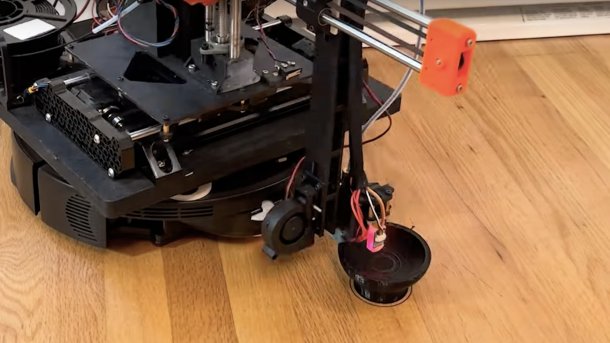
The mobile 3D printer prints any objects on floors.
(Image: MakeabilityLab [Screenshot])
Scientists at the University of Washington and Purdue University have built MobiPrint, a mobile 3D printer that can print its products on the floor in any room. A robot vacuum cleaner serves as a mobile base on which the researchers have mounted a 3D printer with an extension arm. The printer can print three-dimensional signs on the floor or small ramps for people with walking difficulties.
3D printing is "pretty mature", says Daniel Campos Zamora, PhD student at the Paul G. Allen School of Computer Science & Engineering. "Now we're asking: How can we bring it further and further into the world and lower the barriers for people to use it? How can we change the built environment and tailor spaces to people's specific needs – for accessibility, to taste?"
The mobile 3D printer essentially consists of a disused robot vacuum cleaner that provides MobiPrint with the necessary mobility, as the researchers describe in the study "MobiPrint: A Mobile 3D Printer for Environment-Scale Design and Fabrication" (PDF), which was published in the proceedings of the ACM Symposium on User Interface Software and Technology. The scientists have attached a 3D printer to the robot vacuum cleaner, which can be controlled wirelessly. It has been modified so that it can print objects directly on flat floors using an extension arm.
Videos by heise
To be able to place a print in a room, MobiPrint must first detect the room. This is done autonomously using a lidar system. If you like, the scanned room is then a kind of canvas on which the 3D print can be positioned. The user can use a design tool to determine which object should be printed where.
3D printing on the floor
The researchers have already integrated some finished designs into a MobiPrint database, such as a bowl for cat food. However, users can also upload and print their own creations. The user then positions the selected object at a suitable location in the captured space and scales it to their own requirements. The robot then moves to the predetermined location and prints the object on the floor. The printer uses conventional polyactide (PLA) filament for this.
Empfohlener redaktioneller Inhalt
Mit Ihrer Zustimmung wird hier ein externes YouTube-Video (Google Ireland Limited) geladen.
Ich bin damit einverstanden, dass mir externe Inhalte angezeigt werden. Damit können personenbezogene Daten an Drittplattformen (Google Ireland Limited) übermittelt werden. Mehr dazu in unserer Datenschutzerklärung.
The range of applications for the mobile 3D printer is diverse, say the scientists. For example, the 3D prints can be used to print warning signs on the floor, build ramps for people with walking difficulties or simply embellish rooms with sculptures.
However, the idea goes even further, as Jon E. Froehlich, Professor at the Paul G. Allen School, explains. He is thinking of sending the mobile 3D printer out onto the street to print objects at will and create reconfigurable environments. In future, MobiPrint will also be able to print on other surfaces such as walls. It will also be able to print on other materials, such as concrete. According to the researchers, the mobile printer could later tear down the objects itself and recycle the material.



(olb)

