


Almost 30 years of MetaGer: About the history and current developments
The privacy-friendly search engine MetaGer is now only available for a fee following a sudden termination by Yahoo. What happens next.
(Image: heise online)
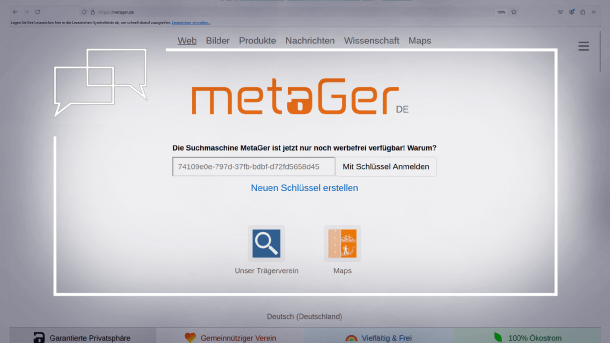
MetaGer is a data protection-friendly search engine that has recently only been available for a fee. To do this, tokens must be purchased –, which is also possible in analog form and without data traces via a letter. The reason for the termination of the ad-financed search is that MetaGer's partner Yahoo is discontinuing operations in Germany. This means that search results via the ad-financed search are no longer possible.

(Image: Christime Plote)
The association is not only significantly involved in the operation and development of MetaGer, but also in educational and research projects. The work is carried out by students from the University of Hanover, volunteers and remaining permanent employees, among others. We spoke to Phil Höfer from the Suma-ev board about the history of MetaGer, challenges after the termination by Yahoo and perspectives.
heise online: What conclusions do you draw after around 30 years of MetaGer?
Phil Höfer: The public perception of search engines is different from the reality. Most people have a distorted picture of what a search engine actually does. We have also noticed that the market is changing. In some aspects, we were slightly ahead of the market. We are currently seeing new search engines that are based on a paid model from the outset. However, the air for ad-financed search engines is generally getting thinner.
So there is movement in the segment?
The end of our ad-financed version is probably a harbinger of a general development. This trend is likely to continue.
How did the collaboration between Suma-ev and the University of Hanover begin?
MetaGer started as a project of the University of Hanover. MetaGer was initiated by a member of staff at the university, Dr. Wolfgang Sander-Beuermann. His idea was brought to the university, initially to the university's computer center.

(Image: MetaGer)
The association only came into being later. After the association officially became the project's sponsor in 2012, students continued to run the project. I started working as a student at Suma-ev in 2013 – and still do today. As a result, there is also a close connection with the University of Hanover. Back then, there was a computer in the computer center and we worked spontaneously on MetaGer – in the live environment. This is no longer the case today. The whole thing was also implemented by students – mostly from the fields of computer science, business informatics and related areas.
MetaGer is open source and many different people have contributed to the search engine over the years. What is the biggest obstacle?
We are convinced that one of the biggest problems with free software is ensuring consistency. The creative energy and good intentions of the people who want to work on it have to be coordinated. There are many individual, smaller forces at work that need to be steered in an orderly fashion. Whereas in a commercial project, you have a project manager, a project team and then there is a strict hierarchy that tells you what direction to take. When working with volunteers, their commitment should of course also be taken into account. That's why the association as a structure is very important. It's similar with Mastodon, for example. Without the founder, Eugen Rochko, who is the main developer there, development would have become much less structured.
Google regularly receives fines, but that doesn't really seem to help. What do you think about this?
It's quite nice that penalties are imposed for exploiting a dominant market position. However, it has little effect. In our opinion, conditions are more helpful, such as the "choice screen". With this, the EU wants to ensure that Google also offers a choice. The requirements are at least a step in the right direction. However, it is much more important to create an atmosphere in which alternatives can emerge and grow in the first place. It's not just a Google problem.
Google has become big, but other search engines can no longer achieve this size because there are no corresponding rules on the market. We are therefore also looking at the Open Web Index. Such projects should receive much more support or public funding so that others can also enter the market, which is currently not possible.
No German company can build the data centers that Google needs to run its search from one day to the next. So many billions have been invested in them that they cannot simply be made up for later. A European infrastructure such as the Open Web Index could help to reduce entry costs into the market. It needs conditions under which competition can develop.

This means that the first half is characterized by conditions that often seem better than nothing, but are rarely really effective. It is much more important to create conditions in which competition can develop. This means less strict regulations and more support. This raises the question of whether it is even possible to fight against this and whether there is a chance.
On the first question you raised: From a legislative perspective, there are opportunities to create better conditions. On the second question of how much influence users really have, I would say that this is comparable to elections. Individual users don't have much influence on their own, but in the masses they can have a big impact.
For example, if Google has a dominant market position of around 70 percent and a large proportion of users, let's say 30 percent, switch to another search engine such as Bing, this would significantly harm Google. In this sense, the user community as a whole has a great deal of leverage. Individuals are only a small part of the whole, but collective action can force companies to adapt their strategies. After all, these companies are worthless without their users.
How did the MetaGer community react to the news of the discontinuation of free search?
Great, much greater than we ever dared to dream. In the first two days after the changeover, we had, if I had to estimate, over 200 new membership applications.
I found that very pleasing. But even more important and emotional were the personal messages we received via social media and email, as well as the encouragement to continue. I also received a lot of support from managing directors of other search engines. Digitalcourage immediately launched an appeal to support us. That really touched us.
Despite the new payment requirement for using MetaGer, we can see that some people are willing to continue paying and using the service. We have realized that we need to make the website more user-friendly. Today we have already gone live with a change to the home page to structure it better. There is still a lot of work to do to develop the website further, but I am confident that we will be able to smooth out the "rough edges" over the next few weeks.
Our mailbox was full again this morning, not only with payments, but also with encouraging letters expressing gratitude and appreciation. That meant a lot to us.
Approximately how many users did MetaGer have?
As we have no tracking data or cookies to count individual users, our internal estimates are very unreliable. What is certain is that we had around 300,000 individual searches per day before the event and just under 10,000 afterwards. It remains to be seen how the trend will develop, but for the last three days there have been more searches every day than the day before.
What helps to maintain Suma-ev MetaGer?
Become a member of the association and if you can't or don't want to, keep using MetaGer, spread the word and don't give up. That's what helps us the most at the moment.
Are there any plans to migrate the services to other platforms or services?
It doesn't look like there are at the moment. We are confident that enough people will continue to use MetaGer. MetaGer as it existed a week ago no longer exists, but MetaGer itself still exists. We hope to find a solution for our users in the coming months. We are aware that it is unfortunate that users are currently unable to use the service as usual. We are working hard to find ways to make this possible.
Do you now know more about the termination by Yahoo?
Our information is that Yahoo has completely discontinued this business model in Germany. We don't know exactly how big this business was. Yahoo uses the Bing index, and I have heard that contracts with Bing may contain a clause that allows contracts to be terminated early. So I suspect that Yahoo is quite safe in this respect.
We need to check whether we are still entitled to the search results until May, as was originally agreed. Thanks to the many new members and donations, we have the prospect of continuing to exist as a legal entity. We still need to clarify how we will proceed, as we have only been in this new situation for a week. We will know more in a week and even more in two weeks.
At the moment, we are planning everything very carefully and hope that everything works out as planned. We have no room for additional safety buffers. However, we are certain that we can continue to operate MetaGer as it is today.
What were MetaGer's most important milestones?
I would count March 1996as one of the most important milestones. The idea for MetaGer was born at CeBIT, and the search engine was developed and implemented by students in the same year. In 2012, the sponsorship changed to Suma-ev and since then there has been an innovation every year. In 2013, we introduced our TOR service, which was a unique selling point at the time. This was followed in 2014 by the introduction of the anonymous proxy service labeled "open anonymously".
From 2015 to 2016, we completely rewrote MetaGer. Originally, the code was programmed in Perl, which is considered difficult to read. We invested a lot of time in making MetaGer more maintainable and user-friendly.
An important success of the modernization was also the significant reduction in search times. I still remember the old website where there was a button for a search. Back then, users were advised to get a coffee while searching because it took so long. That was back in the 90s.
In 2016, an important milestone also happened when we went open source and introduced the GNU-AGPL license (GNU Affero General Public License), which we still use today.
In 2017, we launched ad-free search, first for members and later for the general public, which was very important to us. If we hadn't introduced it back then, it probably wouldn't exist today, which would have meant our demise.
We already had this dependency back then and said that we would prefer to have an alternative, also because we don't like advertising ourselves. We are a non-profit organization and work with free software. But we used to earn our money through advertising because that was the only model at the time. The view was that everything on the web had to be free of charge and search engines too. We were surprised how well it worked when we offered MetaGer ad-free. Microsoft's release of the new Bing, which incorporates a version of OpenAI's language model, has also led to higher costs for search results in the market, which has reinforced the need for paid search.
It has become clear that many people are willing to pay for an ad-free service. We were surprised that it wasn't just us who wanted such a service, but also many users. Since 2017, the number of users willing to pay for the ad-free service has grown steadily. We were in good spirits and were looking for an alternative business partner to Yahoo in order to become more independent. We believed that the market for services where you pay with money instead of data is growing and more and more people prefer this.
Since January of this year, we have also been offering accessible help in easy language. This was a project by students at the University of Hildesheim, which we supported because we thought it was good and right. It also fits in well with the new accessibility laws that have come into force.
Since 2015, we have set ourselves the goal of meeting the WCAG 2.0 criteria for accessibility (Web Content Accessibility Guidelines, the globally dominant standard for accessible digital content). We have received good feedback from the Federal Employment Agency about our accessibility.
But don't they also have the idea of financing or co-financing MetaGer?
We even suggested this, but ultimately it is difficult for a public authority or the IT department of a public authority to sell something like this to their superiors. That's a shame, because in theory there is state funding, and if something costs money, it should be paid for. It is still financed by advertising. The authority is basically paying for its employees to see advertising. It is a strange business model that the employees of a public authority see advertising in order to reduce the authority's expenses.
We need to think hard over the next few months about options like this, which previously seemed rather unimportant but have now become very relevant. I think we have many options for thinking about alternative funding models and securing operations. It's less about expansion, which was never our goal, and more about securing the business within a conservative framework.
Our aim has always been to see ourselves as a continuation of a university project in the areas of research, teaching and general education. We have ongoing projects such as the school project and the Suma scholarships, which we use to support final year projects at universities.
Are there any lessons or insights from running MetaGer that could be useful for future projects?
Then I would say: stay calm, stay relaxed and don't take any unnecessary risks. We could never have foreseen what has happened now, but we have managed to continue to exist. In that time, we've seen several major search engines come and go. MetaGer has been around since 1996. Consistency is more important than constantly founding new start-ups. Keeping calm is the key.


(mack)

