

Electric car: Hyundai Inster Long Range compact car with plenty of space
In South Korea, the Hyundai Casper is one of the most sought-after small cars. Now it is also coming to Europe as the casual Hyundai Inster.

(Image: Hyundai)
- Stefan Grundhoff
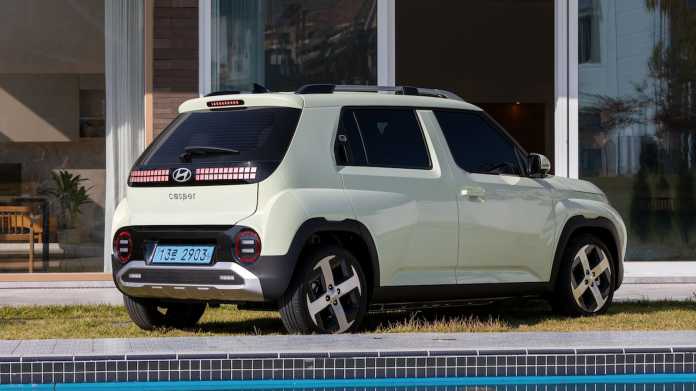
In South Korea, the Hyundai Casper with its cool 80s design is one of the most sought-after small cars. Now its electric version is coming to Europe under the name Hyundai Inster. Its chubby, cuddly design with an 80s retro touch and hints of SUV makes it a real eye-catcher. But with its extroverted appearance and nice ideas, it doesn't just want to be part of Asian pop culture. One like it has been eagerly awaited in Europe for a long time, and it is also a well-made car with very realistic, intelligent details.
The car is based on the Casper, which is now very successful in South Korea, and with its electric drive it is almost 25 centimeters longer at 3.83 meters. 15-inch rims are standard, wheels with a diameter of 17 inches are the maximum available at extra cost. Big for such a compact car. The extended wheelbase creates space for a battery pack of up to 49 kWh, more living space in the rear and a more comfortable ride.
Large compact car
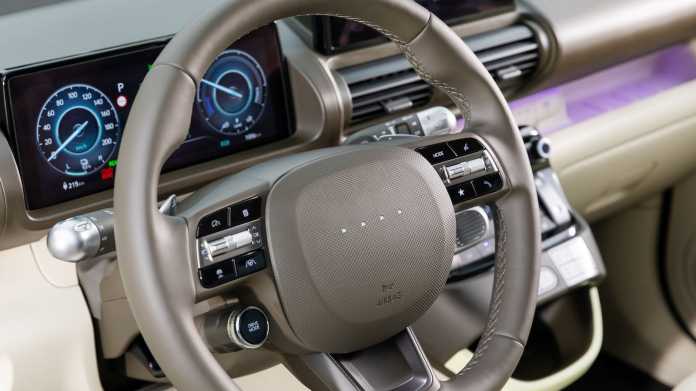
The front seats made a good impression, but there was no time for a more meaningful long-distance test drive. Despite the external dimensions, even adults up to 1.90 meters tall can sit in the back – including their own doors. Plenty of space at the front and rear, clear 10.25-inch displays and simple operation via direct selection buttons make a very grown-up impression.
Hyundai Inster II (9 Bilder)
Hyundai
)The ergonomics are right, they are intuitive in almost every respect, some things are new. Like the larger models, the Inster opens and closes with a smartphone. The pixel rear lights are indicated by four square diodes in the steering wheel and the ambient lighting flashes in the event of warning messages. The fact that the circular headlights in the basic version are still fitted with bulbs is somewhat surprising in this modern environment.
Comfortable suspension
The drive mode is selected with a lever behind the steering wheel, as in a Mercedes, which is a good idea as it saves space. When setting off, it lacks the punch we are used to from many electric cars, but the 147 Nm of torque are still impressive. In city traffic, the Inster impresses with a surprisingly comfortable chassis and direct, albeit slightly decoupled steering, which is probably tuned this way because of the front-wheel drive. Compared to many modern cars, the rather large windows allow a good all-round view, except in the direction of the wide C-pillars.
There are storage compartments and practical hooks everywhere, plus comfort details such as air-conditioned seats or an optional panoramic roof for light and air. All four seats can be folded down if required, making it possible to enjoy a short camping trip or a quick office break in the parking lot or at the next loading stop. The load volume can be increased from 238 to 351 liters thanks to the folding and 16-centimeter sliding rear bench. If the backrests of the second row are folded down, up to 1059 liters are available.
Hyundai Inster I (12 Bilder)
Hyundai
)"Long range" is relative
The entry-level version offers a combination of a small battery pack with 42 kWh and a 71 kW electric motor on the front axle, while the more powerful version has 85 kW, 147 Nm and a 49 kWh battery. In the latter version, the mini-e-mobile is capable of 150 km/h on the highway, which we were unable to test in Korea.

A fast charger can bring the battery pack from 10 to 80 percent in around half an hour at best – Unfortunately, the charging speed is limited to 85 kW; a three-phase AC charger with 11 kW output is standard. With a standard consumption of 15.3 kWh per 100 kilometers, the large battery pack enables ranges of up to 370 kilometers. "Long range" is relative, but for the urban environment and the statistically recorded normal use of a car, it is more than enough. The Inster offers a vehicle-to-load function inside and outside for external devices for up to 16 A at 230 volts and thus also enables the charging of e-bikes, the operation of power tools or camping equipment.
The new Hyundai Inster is not a cheap offer and does not want to be. However, the base price of less than 23,000 euros is quite an announcement; most European competitors can only dream of a comparable electric entry-level model. The significantly more expensive electric competitor models Mini Cooper E (28,150 euros) or Opel Corsa E (29,900 euros) offer less space, at best the Citroën ë-C3 (from 23,300 euros) and the recently noticeably reduced Fiat 500 Elektro (24,990 euros) can compete in this environment.
(nie)