


Nvidia's high-end CPUs for Windows on ARM to arrive in September 2025
Windows on ARM is set to become much more exciting in 2025. Nvidia is reportedly launching its own high-end processors.
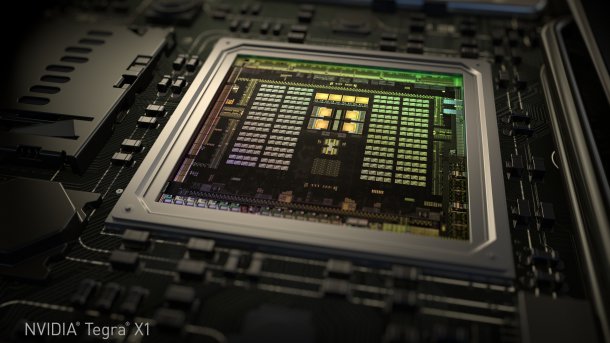
Nvidia used to launch processors with a consumer focus such as the Tegra X1. In recent years, such products have no longer been available.
(Image: Nvidia)
AMD, Intel, Qualcomm and Apple are set to face new competition in September 2025: Nvidia is reportedly planning to unveil its first ARM processors for Windows-on-ARM devices.
This is reported by the Taiwanese news service Digitimes (via Tom's Hardware). According to our information, this primarily concerns high-end processors for notebooks: Nvidia is designing its own complete systems-on-chip (SoCs) with ARM cores and GeForce graphics units.
For the mainstream, Nvidia works together with Mediatek –, the largest processor manufacturer for Android smartphones and smart TVs, for example. Mediatek designs the CPU part and Nvidia contributes a GPU, both of which are placed on a common carrier. The big advantage for Mediatek is that Nvidia has mature graphics drivers, which means the company is spared the dilemma of Qualcomm's Snapdragon processors.
More powerful GPUs in notebook processors
In general, the trend is towards more powerful integrated GPUs in notebook processors. In the analyst conference on the latest business figures, Intel CEO Pat Gelsinger said that he wants to reduce product diversity. He sees a trend towards powerful integrated GPUs that make stand-alone graphics chips at the lower end of the performance spectrum superfluous. According to rumors, Intel is launching a Panther Lake variant with a particularly large GPU, which could arrive in early 2026 as the Core Ultra 300. "Normal" Panther Lakes will appear before then.
One thing is already clear: Intel is dispensing with special memory constellations. Gelsinger presented the LPDDR5X components directly on the Lunar Lake carriers (Core Ultra 200V) as a one-off solution. Originally, Lunar Lake was intended to be a niche product, where the lower margin from purchasing additional memory was accepted in exchange for better battery performance. However, due to the AI boom, Intel then scaled up Lunar Lake, which put an unplanned squeeze on the margin.
Videos by heise
For upcoming notebook processors, modules or memory components soldered onto the mainboards with DDR5/DDR6 or LPDDR5X/LPDDR6 technology are most likely. High-bandwidth memory (HBM) is likely to be too expensive for the market.
AMD is already planning Strix Halo for early 2025, allegedly with 16 Zen 5 cores and 2560 shader cores – 2.5 times as many as in the previous Ryzen AI 300. These models will allegedly come as the Ryzen AI Max 300. AMD is said to be working on its own ARM processors in parallel, although no details are yet known.
Empfohlener redaktioneller Inhalt
Mit Ihrer Zustimmung wird hier ein externer Preisvergleich (heise Preisvergleich) geladen.
Ich bin damit einverstanden, dass mir externe Inhalte angezeigt werden. Damit können personenbezogene Daten an Drittplattformen (heise Preisvergleich) übermittelt werden. Mehr dazu in unserer Datenschutzerklärung.


(mma)


